
How dynasty trusts hold assets across generations
Key takeaway
Dynasty trusts hold family ownership through business interests transferred to the trust. Start by identifying the interests intended for the trust, the governing documents and the decisions future trustees will face.
Business ownership begins with funding
A trust holds only assets transferred to it. Naming a business in a family discussion does not transfer its ownership to the trust.
In Minnesota, for example, trustees may acquire property and continue or create a business involving the trust's business interest, subject to the trust terms and fiduciary duties. Other states differ.
For a Minnesota LLC, a transferee receives the transferred distribution rights. Subject to the charging order statute, transfer alone does not confer management rights or access to company information.
During dissolution and winding up, the transferee is entitled to an account of company transactions only from dissolution onward. The company need not recognize the transferee's rights before receiving notice of the transfer.
A transfer violating an operating agreement restriction is ineffective against a person who knew of that restriction when the transfer occurred.
For the planning conversation, gather the ownership records, operating agreement and proposed transfer documents together. Ask counsel to distinguish the economic interest from the authority to make business decisions.
Delaware distinguishes land from entity interests
Delaware's trust duration provisions distinguish directly held real property from personal property. The following discussion concerns trusts not created through the exercise of appointment powers, which require separate analysis under the statutory qualifications.
Under section 503, trust interests in real property are not invalidated by the common law perpetuities rule or the common law limit on noncharitable purpose trust duration.
Trust interests in personal property are not invalidated by those rules or other perpetuities rules. Covered real property still held in trust must nevertheless be distributed after 110 years.
That period begins at the later of the property's acquisition by the trust or the trust becoming irrevocable. Distribution follows the instrument's provisions for distributing that property upon termination.
Without those provisions, distribution goes to current income beneficiaries in their income proportions, or equally if proportions are unspecified. Without termination provisions or income beneficiaries, distribution goes to the trustor's or testator's then living distributees.
Those distributees are determined under then applicable Delaware intestacy law, as though the trustor or testator had then died intestate, resident in Delaware and owning that real property.
The statutory charitable, employer benefit, filed statutory trust and cemetery care classes are excluded from this duration rule.
For section 503 only, interests in corporations, LLCs, partnerships, statutory trusts, business trusts and other entities are intangible personal property, even when the entity owns land.
If the entity ceases to exist and the trust receives its land, the trust does not become void or subject to termination under the specified perpetuities rules.
Unless the instrument provides otherwise, the trustee may distribute that land under section 503(b) or exchange it for an interest in another qualifying entity.
Review GST exemption separately from duration
An individual or executor may allocate that individual's generation skipping transfer, or GST, exemption to property for which the individual is the transferor. An allocation, once made, is irrevocable.
The GST exemption equals the calendar year's basic exclusion amount. It does not include a deceased spouse's unused exclusion. Allocation timing requires separate review.
The GST applicable rate equals the maximum federal estate tax rate multiplied by the transfer's inclusion ratio. The maximum rate is determined at the taxable distribution, taxable termination or direct skip, as applicable.
A zero inclusion ratio produces a zero applicable rate. The trust's name or duration does not establish that a particular transfer has a zero inclusion ratio.
Bring the funding history and exemption allocation records to the tax review. Ask the adviser to identify what those records establish before discussing the trust's future transfers.
Two related terms
Ascertainable standard: A standard that limits distributions by reference to health, education, maintenance or support.
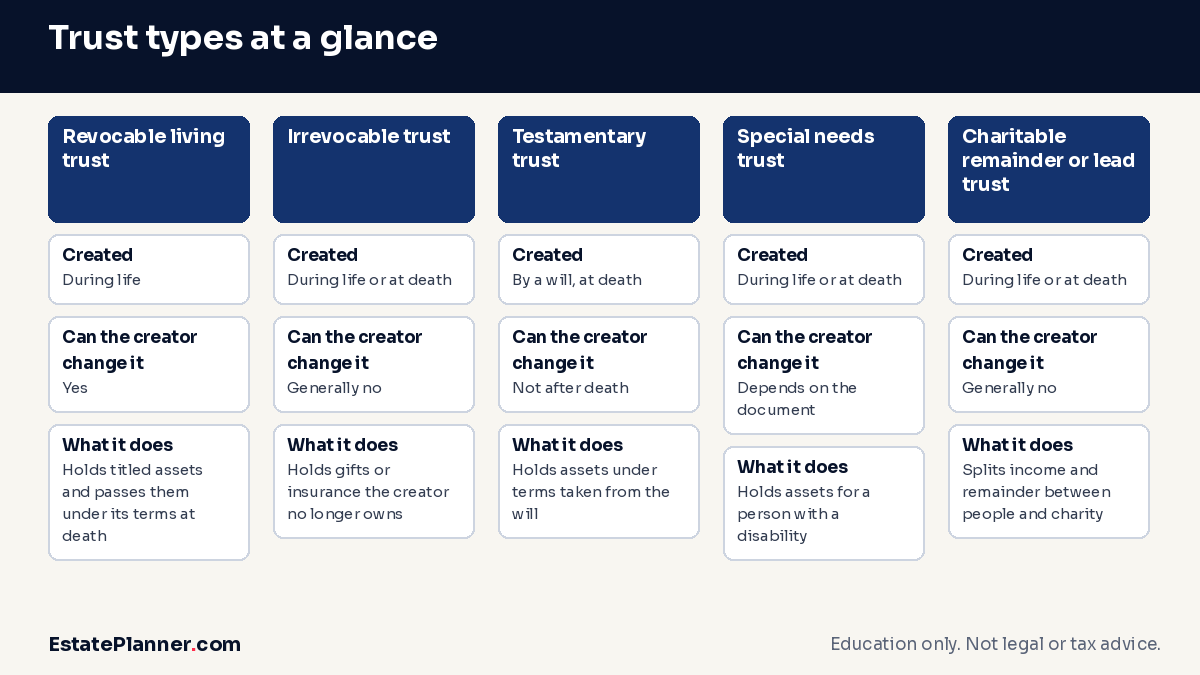
Irrevocable trust: A trust that generally cannot be revoked unilaterally by its settlor. Modification or termination may be available under its terms or state law.
An Investor Advantage perspective
A panel participant described the ambition to build a dynasty among the family office founders interviewed. That ambition is a useful starting point for discussing what the family wants its ownership plan to accomplish.
"And we found that 77% of the founders of family offices want to build a dynasty. And this is where growth comes in in terms of the the family office."
Common questions
Must a dynasty trust retain the family business permanently?
Not necessarily: in Minnesota, for example, the default rule requires diversification unless the trustee reasonably determines that special circumstances make the trust's purposes better served without it. Other states differ.
The trustee must consider the trust's purposes, terms, distribution requirements and circumstances. The instrument may expand, restrict, eliminate or otherwise alter the default prudent investor rule.
Reasonable reliance on the instrument limits trustee liability. The trustee must still review at reasonable intervals whether retaining or disposing of property is advisable.
With two or more beneficiaries, the trustee must administer impartially, giving due regard to their respective interests. These rules do not establish a permanent retention requirement.
Does transferring business interests remove them from the owner's gross estate?
Not automatically: transferred property is included when the decedent retained possession, enjoyment, income or the right to designate who enjoys the property or its income for a covered period.
The designation right may be held alone or with another person. Covered periods are life, a period not ascertainable without reference to death, or a period that does not actually end before death.
The rule excepts a bona fide sale for adequate and full consideration.
When are separate beneficiary shares treated as separate trusts for GST purposes?
When a single trust consists solely of substantially separate and independent shares for different beneficiaries or beneficiary groups, each share is treated as a separate trust for GST purposes.
For this treatment, the shares must exist from creation onward. A trust entirely included in the grantor's gross estate is treated as created at the grantor's death.
Unless local law separately recognizes the trusts, this treatment does not create separate return filing, tax payment or other tax treatment. Additions and distributions are allocated proportionately unless the instrument expressly provides otherwise.
Mandatory severance, pecuniary share and later qualified severance rules require separate review.
Can a court change a trust when unexpected circumstances arise?
Yes: in Minnesota, for example, a court may modify administrative or dispositive terms, or terminate a trust, when unanticipated circumstances make that action further the trust's purposes. Other states differ.
To the extent practicable, modification must follow the settlor's probable intention. Separately, a court may modify administrative terms if continuing them would be impracticable, wasteful or impair administration.
On termination under this rule, the trustee must distribute property consistently with the court's order.
Sources
- Minnesota trustee powers, read with Minnesota trust terms and fiduciary duties.
- Minnesota transfer of an LLC transferable interest, subject to the charging order provisions.
- Delaware trust perpetuities provisions, including property classification, distribution provisions and statutory exceptions.
- Federal GST exemption allocation and basic and applicable exclusion amounts.
- GST applicable rate.
- Minnesota prudent investor rule and impartial administration.
- Transferred property with retained interests.
- GST treatment of separate trust shares.
- Minnesota modification or termination because of unanticipated circumstances.