
How trusts receive property and business interests
Key takeaway
Trusts receive assets through ownership transfers appropriate to the asset. Start with the asset you own, then review its transfer documents, any restrictions and the records needed to track it.
Real estate: distinguish the deed from recording
In California, a properly executed, delivered and accepted deed transfers real property title. Recording informs people dealing with the property and ordinarily determines priority between conflicting claims to the same property.
Subordination or actual notice can affect priority despite recording dates. Recording is therefore not a universal condition for a conveyance to take effect. Other states differ.
A California deed of trust secures a loan against property. It is not the instrument used to transfer property to a living trust.
In Virginia, an instrument purporting to convey real or personal property to a trust instead of its trustees is treated as conveying it directly to those trustees. Other states differ.
Mortgages: the federal protection has conditions
Federal law protects certain transfers into an inter vivos trust from enforcement of a due on sale clause when all the following conditions apply:
- The loan is secured by residential real property containing fewer than five dwelling units, including qualifying cooperative share collateral, or by a residential manufactured home.
- The borrower is and remains a beneficiary of the trust.
- The transfer does not relate to transferring occupancy rights in the property.
The statute permits regulations allowing enforcement for a real property loan and related agreement under which a borrower obtains rights to future income. Review that exception alongside the transfer conditions.
California property tax: revocability matters
In California, a trustor's transfer of real property, or an ownership interest in an entity holding real property, into a trust revocable by that trustor is excluded from change in ownership.
When that trust becomes irrevocable, a change in ownership occurs unless the trustor remains or becomes the sole present beneficiary or another exclusion applies. Other states differ.
Business interests: separate distributions from control
In Minnesota, for example, transferring all or part of an LLC transferable interest gives the transferee the transferred distribution rights without itself causing member dissociation or company dissolution. Other states differ.
Subject to the statutory charging order provision, that transfer does not itself grant management rights or ordinary access to company records or information. During dissolution and winding up, an account is available only from dissolution onward.
The LLC need not recognize the transferee's rights until notified of the transfer. A transfer violating an operating agreement restriction is ineffective against a person who had notice of that restriction when the transfer occurred.
In Minnesota, for example, transferring all or part of a limited partner's transferable interest conveys the transferred distribution rights, including the net amount otherwise distributable on dissolution and winding up. Other states differ.
The transfer does not itself cause dissociation or dissolution or confer management, ordinary information or inspection rights. During winding up, an account is available only from dissolution onward.
The limited partnership need not recognize the transferee's rights until notified. A transfer violating the partnership agreement is ineffective against a person with notice of the restriction at transfer.
For your review meeting, bring the operating or partnership agreement and identify whether the intended transfer concerns distributions, management or both.
Corporate shares: examine restrictions and notice
In Minnesota, for example, corporate securities may carry transfer restrictions in articles, bylaws, shareholder resolutions, or agreements or written actions among shareholders or other security holders, including arrangements with the corporation. Other states differ.
A written restriction must not be manifestly unreasonable. For statutory enforceability, it must appear conspicuously on the certificate or in the required information sent to holders of uncertificated shares.
A conspicuous certificate statement referring to a separate restriction document counts as notice. Previously issued securities are not bound unless their holders agreed to the restriction or voted for it.
Without the required notice, a restriction is ineffective against someone without knowledge of it.
S corporation shares: confirm trust eligibility
A trust wholly treated as owned by one U.S. citizen or resident individual under the grantor trust rules is a permitted S corporation shareholder. Foreign trusts are excluded.
A trust meeting that test immediately before the deemed owner's death, and continuing in existence afterward, may remain eligible under the statutory continuation rule for two years beginning on the death date.
Other permitted trust categories and their elections need separate analysis. This eligibility rule does not establish eligibility for every trust.
Stock options: tax qualification is a separate question
Incentive stock options and employee stock purchase plan options generally must be nontransferable except by will or descent, and exercisable during the individual's lifetime only by that individual.
A transfer to a trust does not disqualify the option under this tax rule if the individual remains its sole beneficial owner under the federal grantor ownership provision and applicable state law.
That tax exception does not establish permission to transfer under an option agreement.
Cooperative apartments: identify the shares and lease
In New York, a cooperative apartment purchaser buys corporate shares allocated to a particular apartment. Ownership of those shares entitles the purchaser to a proprietary lease for that apartment. Other states differ.
Bring the share and lease documents to the funding review so the discussion starts with the ownership structure.
Keep ownership and administration records together
In Virginia, trustees must keep adequate administration records and separate trust property from their own. To the extent feasible, the trust's interest must appear in records maintained by someone other than a trustee or beneficiary.
Property of separate trusts may be invested together if records clearly identify their respective interests. Other states differ.
For digital asset transactions, IRS guidance calls for records sufficient to support federal tax return positions. Keep transaction types, dates and times, units, relevant fair market values, and basis for assets sold or disposed of.
Keep acquisition dates and times, units and acquisition fair market values as well. Recording a value does not itself determine basis.
Two related terms
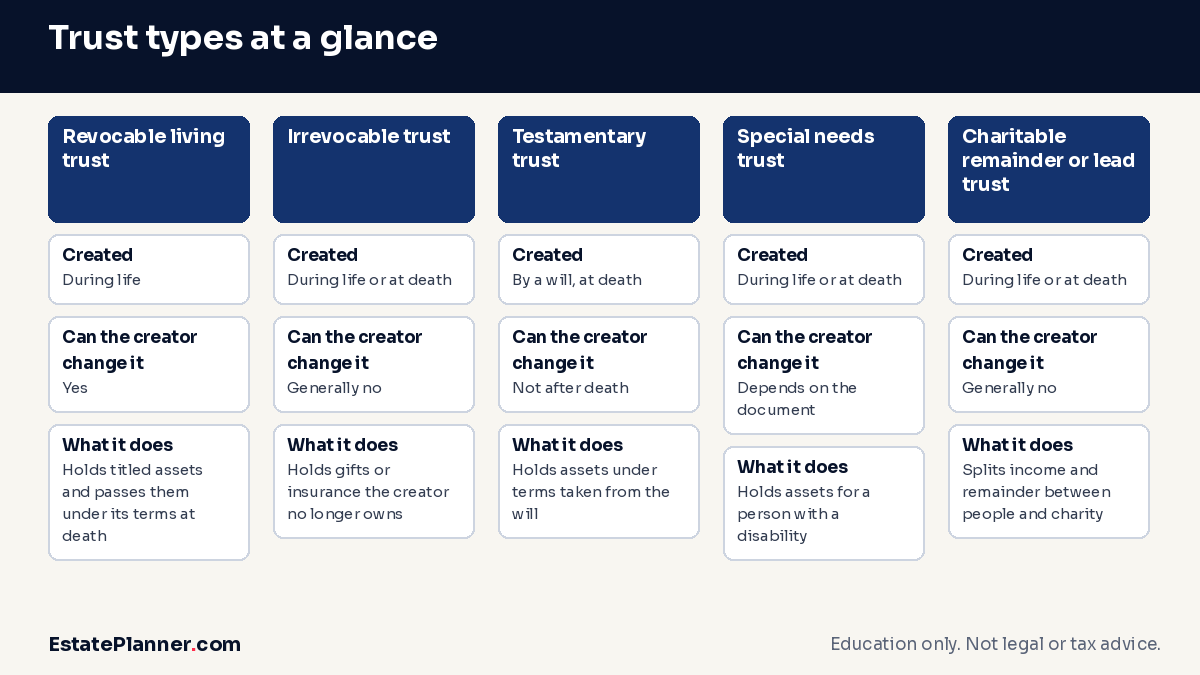
Irrevocable trust: A trust that generally cannot be revoked unilaterally by its settlor. Modification or termination may be available under its terms or state law.
Ascertainable standard: A standard that limits distributions by reference to health, education, maintenance or support.
A business owner's perspective
For business owners, the funding discussion can also prompt a broader conversation about the people involved in an investment.
"I think one of the biggest mistakes I know for a fact that we've made and other people have made in the past and is underestimating the importance of the people you're inheriting when you make an acquisition or an investment"
Common questions
Can I retitle my IRA to a living trust?
No. IRA ownership cannot be moved to a living trust. A withdrawal used to fund a trust is a distribution, included in income to the extent the IRA rules make it taxable.
A trust can be named as beneficiary, which requires separate payout rule analysis. Qualified plans follow their own plan terms and spousal rules. Rollovers and other distribution exceptions are outside this guide.
Does a Florida account beneficiary own the money during the owner's life?
No. In Florida, a beneficiary of an account with a pay on death designation has no right to the deposited money during the owner's lifetime.
At the death of the sole owner, or the last survivor of multiple owners, the money belongs to the surviving beneficiary or beneficiaries. Other states differ.
Sources
- California Board of Equalization: Property Ownership and Deed Recording. Deed execution, delivery, acceptance, recording priority and trust deeds.
- Virginia Code §64.2-772. Transfers naming trusts and trustee recordkeeping.
- 12 U.S.C. §1701j-3(d)(8) and (e)(2). Conditioned protection from due on sale enforcement and future income exception.
- California Property Tax Rule 462.160(b)(2). Transfers to revocable trusts and subsequent irrevocability.
- Minnesota Statutes §322C.0502. LLC transferable interests, restrictions, notice and transferee rights.
- Minnesota Statutes §322C.0504. Charging order provision referenced by the LLC transfer statute.
- Minnesota Statutes §321.0702. Limited partnership transferable interests.
- Minnesota Statutes §302A.429. Corporate securities transfer restrictions and notice.
- Internal Revenue Code §1361(c)(2)(A)(i), (ii) and (B). Permitted trust shareholders and continuation after a deemed owner's death.
- Treasury Regulation §1.421-1(b)(2). Statutory option transfer and exercise conditions.
- New York Attorney General: Cooperatives. Shares allocated to an apartment and proprietary leases.
- IRS: Digital Assets. Acquisition and transaction recordkeeping.
- Internal Revenue Code §408(a) and (d). IRA ownership and distributions.
- Florida Statutes §655.82. Rights in accounts with pay on death designations.