
How irrevocable trusts can change
Key takeaway
An irrevocable trust may sometimes be changed under its terms or state law. The routes below distinguish moving assets to another trust, obtaining consent, responding to unanticipated circumstances and correcting a mistake.
Court changes for unanticipated circumstances
In Minnesota, for example, a court may modify administrative or dispositive terms, or terminate a trust, if circumstances the settlor did not anticipate mean the change will further trust purposes, and other states differ.
Modification must follow the settlor's probable intention to the extent practicable. Separately, the court may modify administrative terms if continuing under existing terms would be impracticable or wasteful or impair administration.
On termination under this provision, the trustee must distribute property consistently with the court's order.
Georgia decanting and its safeguards
In Georgia, unless the instrument expressly provides otherwise, a trustee who contributed no property and has authority to invade principal for beneficiaries may distribute principal to a second trust, independently or with court approval.
A current beneficiary of the second trust must be a current beneficiary of the original trust. Every other beneficiary must also be an original trust beneficiary. Current status is determined on the distribution date.
A separate provision permits an appointment power for an original beneficiary eligible for principal distributions. Its permissible appointees may include people outside either trust.
The trustee must use a signed, acknowledged written instrument retained with the original trust records. The transfer cannot extend the applicable perpetuities period or eliminate enforceable obligations against the transferred property.
Written notice must reach the living settlor, any trust director and those entitled to annual reports under the applicable reporting provisions, taking account of the instrument and statutory reporting qualifications.
The notice must describe the exercise and specify the proposed distribution date. It must precede distribution by at least 30 days.
The statute excludes solely charitable trusts. A trustee who is also a beneficiary remains subject to Georgia's statutory limitations on such trustees.
The exercise cannot prevent or reduce protected tax benefits. S corporation stock cannot pass to a second trust that is an impermissible shareholder. These safeguards are not a complete transaction checklist.
Utah decanting and direct modification
For a trust administered under Utah law, a trustee with discretionary authority to distribute income or principal may distribute it to a separate trust or modify the first trust's terms, subject to the following restrictions.
Express prohibitions on those specified actions control. A generic prohibition on amendment or revocation does not itself prohibit decanting.
Before exercising the power, the trustee must determine whether distribution or modification is necessary or desirable, considering the first trust's purposes, the second trust's terms and the distribution's consequences.
The second trust must have a beneficiary of the first trust eligible for present discretionary distributions or future distributions at a time or event specified in the first trust.
Before modifying the first trust's terms through this power, the trustee must give all beneficiaries written notice at least 20 days beforehand. This notice requirement specifically concerns modification of the first trust's terms.
For contributions qualifying for the annual gift tax exclusion, the second trust must vest the beneficiary's remainder no later than the first trust required.
Decanting cannot reduce protected current income interests in trusts receiving a federal or comparable state marital deduction, charitable remainder trusts, or grantor retained annuity or unitrust trusts.
For property subject to a withdrawal power held by a beneficiary eligible for trustee distributions, decanting requires that the beneficiary's withdrawal power remain unchanged as to that property.
The exercise cannot make the decanting power a general power of appointment. Separately, the second trust may grant an appointment power to a beneficiary of both trusts, including authority to appoint to outsiders.
A separate guide covers Utah's detailed restricted trustee eligibility, self benefit restrictions, distribution expansion and U.S. tax connections.
Colorado consent and settlement routes
In Colorado, on petition, a court must approve modification or termination of a noncharitable irrevocable trust when the settlor and all beneficiaries consent, even if the change conflicts with a material purpose.
With beneficiaries alone, termination requires all beneficiaries' consent and a court finding that continuation is unnecessary for any material purpose. Modification requires their consent and a finding that the change is consistent with a material purpose.
That beneficiary only route excludes trusts established by court order under 42 U.S.C. §1396p(d)(4). A spendthrift provision is not presumed to be a material purpose.
Without unanimous beneficiary consent, the court may approve only if unanimous consent would have permitted the change and the interests of beneficiaries who do not consent are adequately protected.
Colorado also permits binding nonjudicial settlements within specific limits. Required parties are those whose trust interests would be materially affected if the agreement received judicial approval when entered.
The agreement must preserve material purposes and contain terms a court could properly approve under applicable law. Possible subjects include interpretation, accounting approval, trustee powers, trustee replacement and compensation, and administration transfers.
An affected person may ask the court to approve or disapprove the agreement and review representation and whether its terms could properly receive court approval.
Wisconsin consent and notice
In Wisconsin, a noncharitable irrevocable trust may be modified or terminated with the settlor's and all beneficiaries' consent, with or without court approval, even against a material purpose.
A trust described in 42 U.S.C. §1396p(d)(4) additionally requires trustee consent. A representative consenting for the settlor needs specific authorization in a power of attorney, trust terms, or a court guardianship or conservatorship order.
With beneficiaries alone, court approval is required. Termination requires all beneficiaries' consent and a finding that continuation is unnecessary for any material purpose. Modification requires their consent and consistency with a material purpose.
Without unanimity, court approval requires that unanimous consent would have permitted the change and that interests of beneficiaries who do not consent be adequately protected.
A spendthrift provision is not presumed to be a material purpose. A court cannot compel a beneficiary's consent to satisfy that beneficiary's creditor.
A party proposing a change under these consent routes must give notice at least 30 days before its proposed effective date. Recipients are the living settlor, trustee, each trust protector, each directing party and each beneficiary.
Reformation to correct a mistake
Georgia courts may reform even unambiguous provisions to match settlor intention when clear and convincing evidence establishes that a factual or legal mistake in expression or inducement affected the provisions.
A Georgia petition may come from the trustee, any trust director, any beneficiary, or the personal representative for an unfunded testamentary trust. Notice goes to the trustee, any trust director and all qualified beneficiaries.
Utah courts may reform even unambiguous terms to conform to settlor intention upon clear and convincing evidence that both settlor intent and trust terms were affected by a factual or legal mistake in expression or inducement.
Two related terms
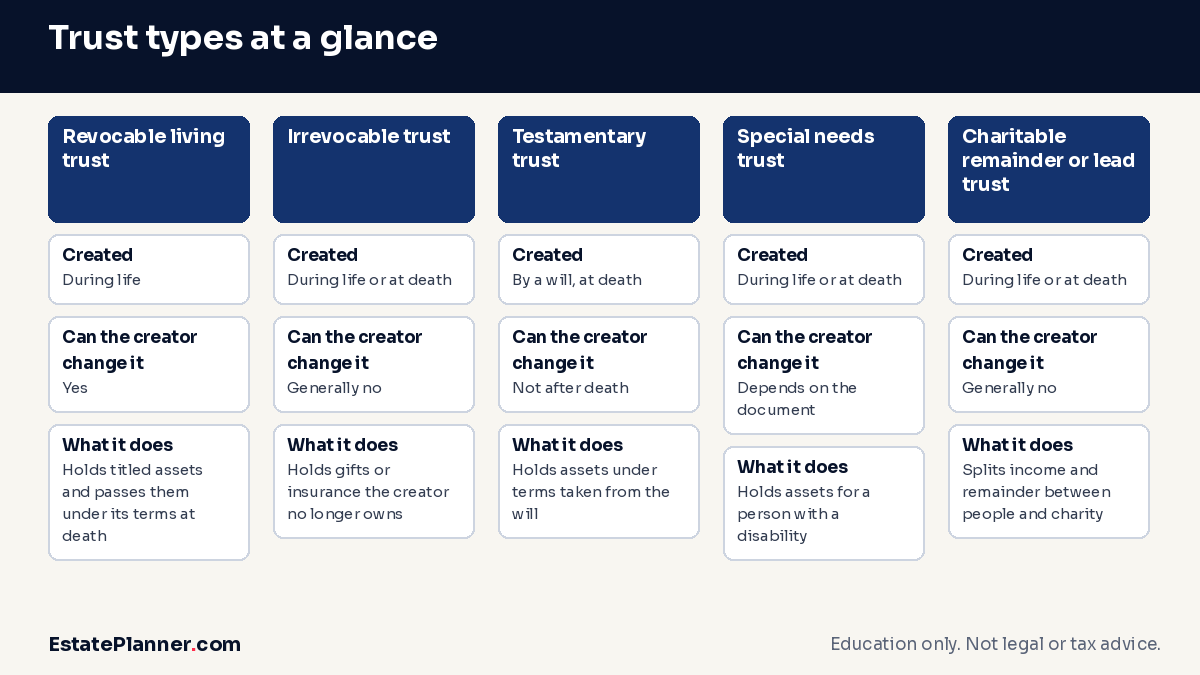
Irrevocable trust: A trust that generally cannot be revoked unilaterally by its settlor. Modification or termination may be available under its terms or state law.
Power of appointment: Authority for a person to designate who receives specified property, within the limits of the instrument creating the power.
An adviser's perspective on evolving work
One speaker described how his practice evolved from its original estate planning focus toward working across different systems.
"our focus is always started from the defense perspective. taxes, asset protection, estate planning. That always drove everything. But really, over time, what's what what's happened for us is that we've become the converter between various systems."
Common questions
Can a court modify a trust to pursue tax objectives?
Yes. In Minnesota, for example, a court may modify trust terms to achieve the settlor's tax objectives in a manner not contrary to the settlor's probable intention, and other states differ.
The court may give the modification retroactive effect. This state authority does not independently establish the federal tax consequences.
Can adding grantor tax reimbursement create a beneficiary gift?
Yes, on the facts of a nonprecedential IRS memorandum involving an irrevocable grantor trust, beneficiary consent and a court modification adding discretionary reimbursement that neither state law nor the original instrument authorized.
The reimbursement covered the grantor's income taxes attributable to trust income. The IRS concluded that beneficiaries made taxable gifts by relinquishing part of their interests.
The IRS stated the same result for failure to exercise a statutory objection right in that modification setting. The memorandum cannot be used or cited as precedent and does not establish that every consent or silence creates a gift.
Is there a GST modification safe harbor for an already exempt trust?
Yes. For an already exempt trust, the modification safe harbor requires a qualifying change that neither shifts beneficial interests to a lower generation nor extends vesting beyond the period in the original trust.
It covers judicial reformation or nonjudicial reformation valid under applicable state law, including specified changes outside the separate distribution, settlement and construction provisions.
A shift includes a possible increase in a generation skipping transfer or creation of a new one. The comparison is between the trust immediately before modification and its effect when modified.
An indeterminate effect is treated as a lower generation shift. Administrative changes that only indirectly increase transferred amounts are excluded from that shift test.
This safe harbor does not establish initial exempt status or address the separate discretionary distribution safe harbor.
Sources
- Georgia House Bill 865, as passed House and Senate. Reformation and decanting provisions, including notice, beneficiary limits, appointment powers and safeguards.
- Utah Code, Title 75B, Chapter 2. Section 75B-2-812.5 and the reformation provision.
- Colorado Revised Statutes, Title 15. Sections 15-5-411 and 15-5-111 on consent and nonjudicial settlements.
- Wisconsin Statutes §701.0411. Consent routes and subsection (7) notice requirements.
- Minnesota Statutes §501C.0412. Unanticipated circumstances, administrative difficulty and distributions upon termination.
- Minnesota Statutes §501C.0416. Modification to achieve settlor tax objectives.
- IRS Chief Counsel Advice 202352018. Nonprecedential analysis of adding discretionary grantor tax reimbursement.
- Treasury Regulation §26.2601-1(b)(4)(i)(D). Modification safe harbor for an already exempt trust.