
How a trust's state connections affect its administration
Key takeaway
A trust's state connections matter for governing law, administration, jurisdiction and taxation: In Minnesota, for example, moving its principal administration there submits the trustee to Minnesota court jurisdiction regarding the trust, and other states differ.
Start with the trust's terms, then compare the state rules for the particular issue. The examples below distinguish a choice of law from an administration location, a transfer procedure and a tax connection.
Virginia: which law interprets the terms
In Virginia, the meaning and effect of trust terms follow the designated jurisdiction's law unless that choice conflicts with a strong public policy of the jurisdiction having the most significant relationship to the matter at issue.
Without a controlling designation, the law of the jurisdiction having the most significant relationship to the matter applies. Other states differ.
Colorado: administration connections and transfer notice
In Colorado, a designated principal place of administration is valid and controlling if a trustee resides or has its principal business there, or if any administration occurs there. These are alternative sufficient connections, and other sufficient connections remain possible.
The trustee has a continuing duty to administer at a place appropriate to the trust's purposes, administration and beneficiaries' interests.
A transfer under the statutory route must further that duty. Qualified beneficiaries must receive notice at least 60 days before the trustee initiates the transfer.
The notice must name the destination, provide the trustee's new address, email and telephone number, explain the reasons, state the anticipated transfer date and set an objection deadline at least 60 days after notice.
A qualified beneficiary's objection suspends the trustee's statutory transfer authority pending resolution. Courts retain authority to order, approve or disapprove a transfer. Other states differ.
Pennsylvania: written consent for the statutory route
In Pennsylvania, the statutory situs transfer route without court approval requires every qualified beneficiary's written consent and a destination connection immediately before or after transfer.
The destination must have a resident trustee, a trustee's principal business, some trust administration or a resident beneficiary.
Qualified beneficiaries must receive at least 60 days' notice identifying the destination, the trustee's new address and telephone number, reasons and anticipated transfer date.
The notice must also state the resulting venue, identify the court and its address, and explain that transfer occurs only if all qualified beneficiaries consent in writing.
Silence does not provide written consent. A situs change does not discharge claims against the trustee. A separate court route is described below. Other states differ.
Utah: governing law and administration
In Utah, a trust provision selecting Utah law for validity, construction and administration makes Utah law govern those subjects if any administration occurs there.
Unless the instrument otherwise designates, Utah administration means either a Utah administration designation with some administration there, or a Utah business location where the fiduciary transacts a major portion of the trust's administration.
Other states differ.
Utah: a timely objection ends statutory transfer authority
In Utah, a qualified beneficiary's objection received by the specified deadline terminates the trustee's authority under the principal place transfer statute.
The transfer must further the continuing duty to administer at a place appropriate to the trust's purposes, administration and beneficiaries' interests. Qualified beneficiaries must receive notice at least 60 days before transfer begins.
The notice must identify the destination, the trustee's new address and telephone number, reasons, anticipated transfer date and an objection deadline at least 60 days after notice.
Courts retain authority to order, approve or disapprove a transfer. Other states differ.
Tax connections need their own review
In Kaestner, beneficiary residence alone did not permit North Carolina to tax undistributed trust income when the beneficiaries received no income during the relevant tax year, could not demand it and could not count on ever receiving it.
The Supreme Court reserved situations involving different relationships between beneficiaries and trust assets. The holding does not establish an exemption from every state trust tax.
California's Form 541 instructions state that California source income is taxable regardless of fiduciary and beneficiary residence.
For income from outside California retained and allocated to principal, taxability depends on fiduciary and noncontingent beneficiary residence. A noncontingent beneficiary has an unconditional interest in income or corpus.
An interest subject to a condition precedent does not count for this purpose. Other states differ.
Two related terms
Grantor trust: When a grantor is treated as owner of a trust portion, the grantor reports that portion's income, deductions and credits. Income tax ownership and inclusion in the gross estate are separate tests.
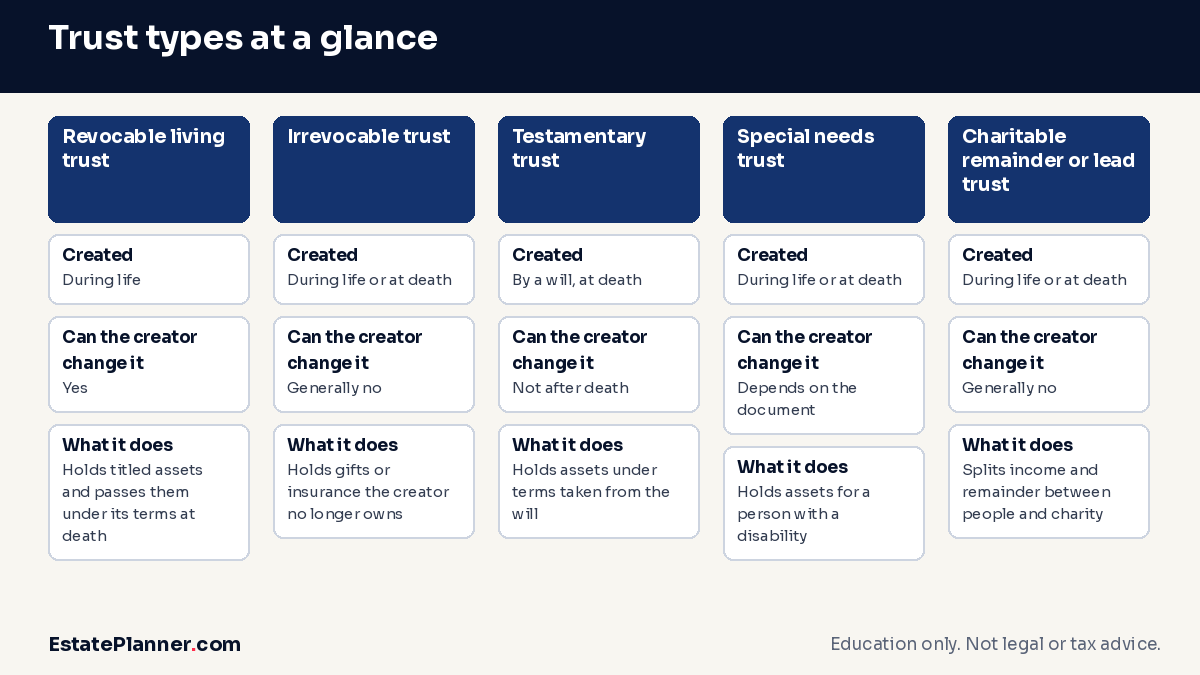
Irrevocable trust: A trust that generally cannot be revoked unilaterally by its settlor. Modification or termination may be available under its terms or state law.
EstatePlanner.com resources to open next
- Multistate estate facts and questions checklist. Open this before your next review to organize the people, property and locations you want to discuss alongside the trust's terms.
- Basis and trust tax records and questions checklist. Use this to prepare the tax records and questions for a separate conversation about your trust's state connections.
- How irrevocable trusts can change. Open this if your question concerns changing the trust's terms as well as its administration location.
- Trusts. Return to the trust hub to choose the guide that matches your next question about trust types or funding.
Perspective across systems
"our focus is always started from the defense perspective. taxes, asset protection, estate planning. That always drove everything. But really, over time, what's what what's happened for us is that we've become the converter between various systems."
Common questions
Can a Pennsylvania court approve a situs change through a separate route?
Yes. A court with jurisdiction may direct a change it finds necessary or desirable for proper administration, on application by a trustee or interested party, after court directed notice, any necessary master's report and any required accounting.
This route applies notwithstanding other chapter provisions. Missing written consent under the statutory transfer route does not establish that every route is unavailable. Other states differ.
Are beneficiaries also subject to Minnesota court jurisdiction?
Yes. In Minnesota, for example, beneficiaries of a trust principally administered there are subject to personal jurisdiction regarding their interests in the trust.
Accepting trusteeship of a trust principally administered there also submits the trustee to personal jurisdiction concerning the trust. Other grounds for personal jurisdiction remain available, and other states differ.
What makes a trust domestic for federal tax classification?
Both tests must be met: a United States court must be able to exercise primary supervision over administration, and one or more United States persons must control all substantial decisions.
Apply the trust instrument and applicable law to both tests on any day classification is determined. A foreign trust is any trust other than a domestic trust.
Sources
- Virginia Code, section 64.2-705: governing law, the public policy exception and the fallback rule.
- Colorado trust administration provisions: administration connections, continuing duty, notice and objections.
- Pennsylvania Trust Code, Chapter 77: situs transfer, written consent and the separate court route.
- Utah Trust Code, Chapter 2: governing law, administration and transfers.
- Minnesota Statutes, section 501C.0206: personal jurisdiction over trustees and beneficiaries.
- Supreme Court opinion in Kaestner: beneficiary residence and the limits of the holding.
- California Form 541 instructions: income source and fiduciary and beneficiary residence.
- Treasury Regulation section 301.7701-7: domestic and foreign trust classification.
- Internal Revenue Code section 671: reporting income, deductions and credits attributable to an owned trust portion.