
Business succession paths
A business interest can pass within the family, to co-owners, to an outside buyer or end through closing.
What the chart shows
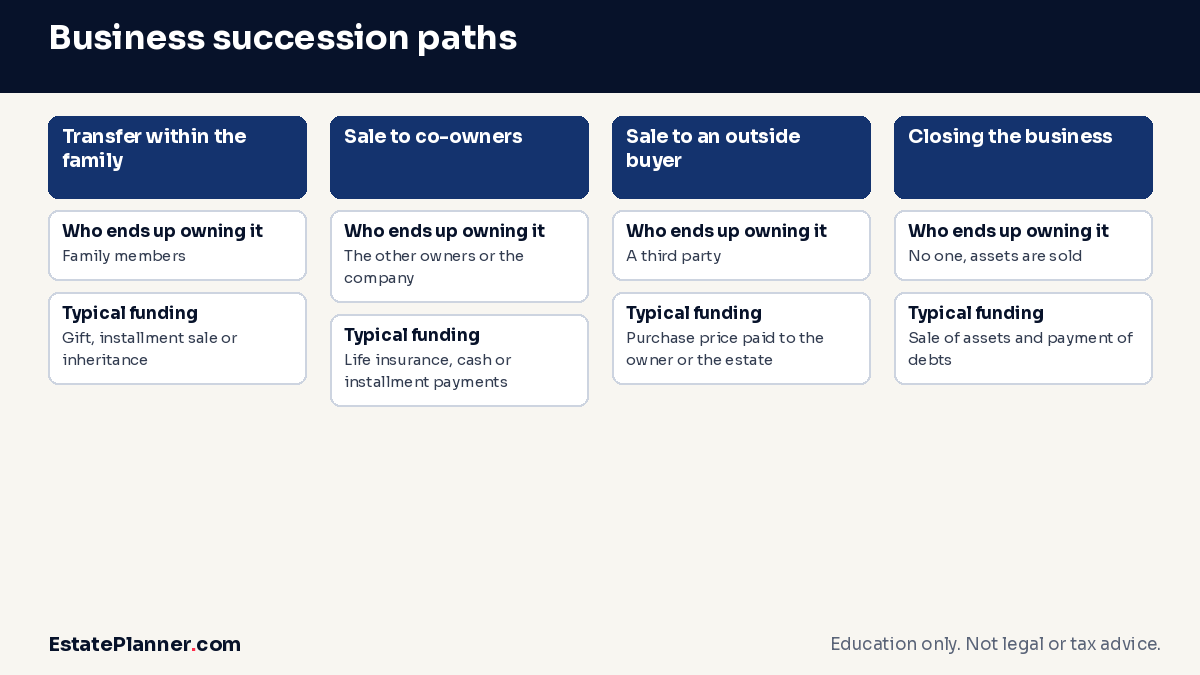
The chart presents four paths for business succession and identifies who ends up owning the business in each path. It pairs each ownership outcome with a typical funding source, from a transfer within the family to closing the business.
Together, the rows describe ways ownership can remain with family members, move to co-owners or an outside buyer, or end when assets are sold and debts are paid. The funding column names forms of payment or other funding associated with each path.
How to read the chart
Read the first row for a transfer within the family. Family members end up owning the business, with a gift, installment sale or inheritance listed as typical funding.
The next row describes a sale to co-owners, where the other owners or the company end up owning it. Life insurance, cash or installment payments are listed as funding for that path.
The third row follows a sale to an outside buyer. A third party ends up owning the business, and the purchase price is paid to the owner or the estate.
The final row covers closing the business. No one ends up owning it, assets are sold, and the listed funding is the sale of assets and payment of debts.
Where owners see this in practice
Owners of businesses can read the four paths by who would end up owning the business and how the path is funded.
The same rows include a sale to an outside buyer, where a third party owns the business and the purchase price goes to the owner or the estate. Owners of real estate or private investments can read the same categories of ownership outcome and funding. Closing is represented as a path where no one ends up owning the business because assets are sold and debts are paid.
The data behind the chart
A business interest can change hands in four main ways, each with a different buyer and funding source.
| Path | Who ends up owning it | Typical funding |
|---|---|---|
| Transfer within the family | Family members | Gift, installment sale or inheritance |
| Sale to co-owners | The other owners or the company | Life insurance, cash or installment payments |
| Sale to an outside buyer | A third party | Purchase price paid to the owner or the estate |
| Closing the business | No one, assets are sold | Sale of assets and payment of debts |
Common questions
Which path keeps ownership within the family?
Transfer within the family ends with family members owning the business.
What happens when a business is closed?
Assets are sold, and the listed funding is the sale of assets and payment of debts.