
How an ESOP transfers a business to employee ownership
Key takeaway
An employee stock ownership plan can provide a business succession path by acquiring qualifying employer securities, subject to plan qualification requirements, fiduciary duties and employee protections. Any borrowing and proposed tax treatment require their own review.
For an owner considering employee ownership, organize the review around the plan, the shares, the purchase price, any borrowing and the tax questions. Start with the company records and proposed transaction documents, then work through the sections below with the advisers reviewing the sale.
Research notice: Review the primary authorities in the collapsed Sources section with the professionals advising on the proposed transaction. Ask an attorney and tax adviser to confirm plan qualification, fiduciary responsibilities, financing terms and the tax rules applicable to the sale before acting.
ERISA fiduciary duties
For ERISA fiduciaries, ERISA §1104(a)(1) imposes duties subject to ERISA §§1103(c) and (d), 1342 and 1344. Those duties include:
- Act solely in participants' and beneficiaries' interests to provide benefits and defray reasonable plan administration expenses.
- Exercise the care, skill, prudence and diligence that a prudent person familiar with comparable matters would use under the circumstances.
- Follow governing documents insofar as they are consistent with ERISA.
An eligible individual account plan acquiring or holding qualifying employer securities receives a statutory exception from diversification and from prudence only to the extent prudence requires diversification. Other prudence duties remain intact.
Ask who will address participant interests, reasonable administration expenses and consistency between the proposed transaction documents and the governing requirements.
The company needs qualifying corporate securities
Under §409(l), where the employer has no readily tradable common stock, qualifying common stock must be issued by the employer or a corporation within the specified controlled group. That stock must combine both of these rights:
- Voting power at least equal to the class with the greatest voting power.
- Dividend rights at least equal to the class with the greatest dividend rights.
Noncallable preferred stock can also qualify. It must be convertible at any time into stock meeting the applicable common stock requirements, at a conversion price reasonable when the plan acquires it.
For a business organized as a partnership or LLC, ask counsel to review the actual entity documents and tax classification before proposing a structure. The employer securities provisions do not by themselves establish an LLC's tax classification or a conversion without tax consequences.
Bring the share register and documents describing each class of stock to that discussion. Ask the advisers to mark both the voting rights and the dividend rights.
Valuation and the fair market value requirement
For an eligible individual account plan acquiring or selling qualifying employer securities under ERISA §1108(e), the transaction exemption requires adequate consideration and no commission. For an asset other than a security for which there is a generally recognized market, adequate consideration means fair market value determined in good faith by the trustee or named fiduciary pursuant to the terms of the plan and applicable regulations.
Marketable securities have separate pricing standards. ERISA §1108(e) also covers specified transactions involving other plans when ERISA §1107(a) does not prohibit them.
That transaction valuation rule addresses ERISA transactions rather than estate tax valuation. Keep those valuation assignments separate when asking advisers to explain the purpose and scope of a report.
For valuations concerning plan activities under §401(a)(28)(C), employer securities not readily tradable on an established securities market must be valued by an independent appraiser. The appraiser must meet requirements similar to the regulations under §170(a)(1). This appraisal requirement neither establishes blanket independence for every trustee nor replaces the fiduciary duties described above.
Ask the transaction team to identify the valuation assignment, the appraiser's qualifications and the information used in the report.
Leveraged ESOP financing
To qualify as an exempt ESOP loan under the Department of Labor regulation, a loan must meet the following safeguards together:
- Purpose and terms: The loan must primarily benefit participants and beneficiaries and charge no more than reasonable interest. When made, its terms must be at least as favorable to the ESOP as comparable terms negotiated between independent parties.
- Use of proceeds: Within a reasonable time after receipt, proceeds must acquire qualifying employer securities, repay that loan or repay a prior exempt loan.
- Recourse and collateral: The loan must provide no recourse against the ESOP. Collateral must be limited to securities bought with those proceeds or qualifying collateral from a prior exempt loan refinanced with them.
- Creditor access: Creditor access must be limited to that collateral, contributions other than employer securities made to meet loan obligations and attributable earnings.
- Payments and accounting: Payments during a plan year cannot exceed those contributions and earnings received during or before that year, less prior payments. Those contributions and earnings must be accounted for separately until repayment.
- Default: Transfers on default cannot exceed the default amount. A lender that is a party in interest can receive assets only upon and to the extent of missed scheduled payments.
- Annual collateral release: Generally, release collateral annually by multiplying encumbered securities held immediately before the current plan year's release by current principal and interest paid divided by current plus future principal and interest. Future years must be definitely ascertainable without extensions or renewals. Use the rate at the end of the plan year for future variable interest and the same fraction for every class.
- Principal only alternative: Release based on principal alone is permitted only if cumulative annual principal and interest payments are no slower at any time than level annual payments over ten years. Disregard interest only to the extent recognized under standard amortization tables. Stop using this alternative when renewal, extension or refinancing makes the combined expired duration and new periods exceed ten years.
Use the loan regulation linked below alongside the proposed note, collateral schedule and repayment schedule. Ask the financing advisers to walk through permitted uses of proceeds, creditor access, payment limits, accounting and collateral release as separate review items.
For default provisions, request a written explanation of the assets the lender could receive and how the proposed documents address a missed scheduled payment.
Employee voting and distribution protections
Review participant voting, repurchase rights, distribution timing and diversification elections alongside the proposed purchase. The provisions below have separate conditions and exceptions.
Participant voting directions
Section 401(a)(22) requires a defined contribution plan other than a profit sharing plan to meet §409(e)'s voting requirements when employer stock is not readily tradable on an established market and employer securities exceed 10% of plan assets after acquisition. The statute excepts employers whose trade or business consists of regularly publishing a newspaper for general circulation.
Under §409(e), when the employer has a registration type class of securities, each participant or beneficiary may direct voting of allocated employer securities entitled to vote. Without such a class, the protected directions concern allocated shares on a merger, consolidation, recapitalization, reclassification, liquidation, dissolution, sale of substantially all business assets or a similar transaction prescribed by regulation.
For those specified transactions, §409(e) permits one vote per participant with the trustee voting plan shares proportionally to the participant vote. These voting protections do not establish everyday management authority.
Repurchase rights after a stock distribution
When distributed employer securities are not readily tradable on an established market, the participant generally has a right to require the employer to repurchase them under a fair valuation formula. The exercise periods must include at least 60 days following distribution and, if the right is unused, an additional period of at least 60 days in the following plan year.
For a total distribution, meaning the account balance distributed within one taxable year, the employer may make substantially equal payments at least annually, beginning within 30 days after exercise and lasting no more than five years. Adequate security and reasonable interest on unpaid amounts are required. For an installment distribution, payment must occur within 30 days after exercise.
S corporations and employers whose charter or bylaws restrict substantially all ownership to employees or qualified trusts may provide cash instead of a stock demand right, or distribute stock subject to qualifying resale terms. A bank legally prohibited from repurchasing its stock may satisfy the exception through a cash distribution right. The stock demand right also excludes account portions reinvested under §401(a)(28)(B) or §401(a)(35)(B) or (C).
Distribution timing and payment periods
Under §409(o), if the participant elects, with spousal consent where §§401(a)(11) and 417 require it, distributions must begin within one year after the close of the plan year of separation due to normal retirement age under the plan, disability or death. For other separations, the deadline is within one year after the close of the fifth plan year following the separation plan year. That latter deadline does not apply if the employer reemploys the participant before payments must begin.
Employer securities acquired with a loan described in §404(a)(9) are excluded from the account balance for these purposes until the close of the plan year in which the loan is fully repaid.
Unless the participant elects otherwise, payments must be substantially equal and occur at least annually. The maximum payment period is five years, extended by one year for each $290,000 or fraction by which the account balance exceeds $1,455,000, with no more than five additional years. The dollar thresholds are indexed. The time periods are not. The applicable IRS notice is linked in Sources.
Diversification elections
Under §401(a)(28)(B), a qualified participant has attained age 55 and completed at least ten years of plan participation. During the six plan year election period, the participant may elect within 90 days after each plan year closes to direct at least 25% of the account, adjusted for amounts covered by prior elections. The percentage increases to 50% for the final election year.
The plan may comply by distributing the elected portion within 90 days after the election period ends. Alternatively, it may offer at least three permissible investment options and invest the elected portion according to the election within that same deadline.
The six plan year period begins with the later of the first qualification year or the statutory commencement year, subject to the transition election described in Sources. This provision does not apply to an applicable defined contribution plan under §401(a)(35)(E).
Owner situation for a profitable operating company
An owner evaluating employee ownership can begin with a packet containing the entity documents, stock classes, ownership records, plan proposal, valuation materials and proposed financing terms. Use the packet to ask specific questions about the proposed sale.
Set a meeting agenda that follows the transaction: identify the securities, review the valuation assignment, read any loan terms and separate the seller's tax questions from the plan's qualification questions. Include participant voting, repurchase, distribution and diversification provisions in the plan review.
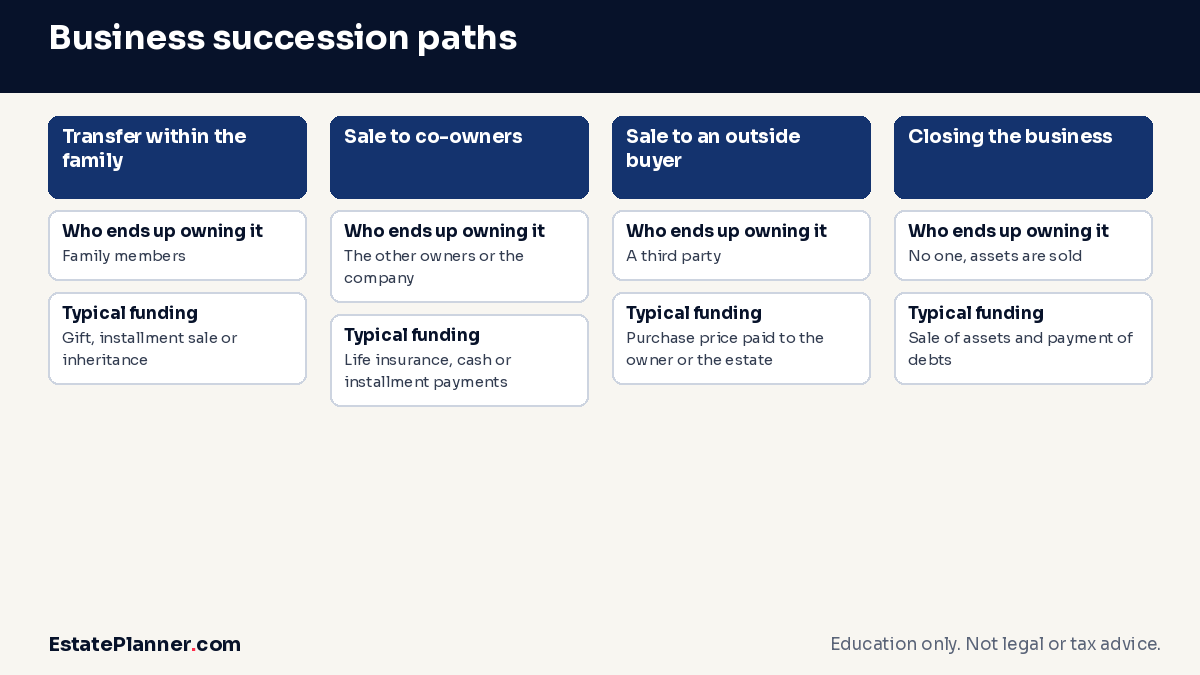
For comparisons, use the business succession paths chart. For records gathering, use the business succession records and questions checklist and bring the resulting packet to the advisers reviewing the employee ownership proposal.
Conditional federal tax treatment
Section 1042 can defer qualifying long term capital gain on a sale only under the following combined requirements and limits. The sale date scope is stated in Sources.
- Seller election: The taxpayer or executor elects by the deadline, including extensions, for the income tax return for the sale year.
- Eligible stock: Securities have been held at least three years, meet §409(l) and were issued by a domestic C corporation with no readily tradable outstanding stock.
- Ownership after sale: Immediately after the sale, applying §318(a)(4), the ESOP owns at least 30% of each outstanding stock class or of total outstanding stock value. Stock described in §1504(a)(4) is excluded.
- Employer consent: The employer's verified written consent to §§4978 and 4979A is filed.
- Excluded sales and gain: The rule excludes securities received from a §401(a) plan or specified stock option or other right transfers under §§83, 422, 423 and their predecessor provisions. It also excludes sales by an underwriter in the ordinary course of that business and gain includible in a C corporation's gross income.
- Replacement period and recognized gain: Qualified replacement property is purchased from three months before through twelve months after the sale. Gain is still recognized to the extent sale proceeds exceed replacement cost.
- Replacement securities: Replacement securities must be issued by a domestic operating corporation other than the sold stock's issuer or its §1563(a)(1) controlled group. Government and political subdivision securities are excluded. The term security otherwise follows §165(g)(2).
- Operating corporation tests: The replacement issuer has no more than 25% passive investment income relative to gross receipts for the taxable year preceding the year the replacement security is purchased. More than 50% of its assets must be used in active business at purchase or before the replacement window ends. Disregard specified §954(c)(3) income for the passive income test. Treat §581 financial institutions and subchapter L insurers as operating corporations. Aggregate controlling and controlled corporations under §304(c), without counting the taxpayer's replacement property when determining control.
Have the tax adviser review the election, stock history, ownership test, employer consent and proposed replacement investments together. Ask for a written explanation of any gain that would remain recognized and the records needed to support the proposed treatment.
Under §1042, unrecognized gain reduces the basis of qualified replacement property purchased by the taxpayer during the replacement period. Allocate the reduction among multiple replacement assets in proportion to each asset's cost. Disregard this basis reduction for §1278(a)(2)(A)(ii).
A later disposition generally recognizes gain up to the deferred amount. A deemed disposition also occurs when a replacement property's issuer substantially disposes of assets outside its ordinary business while the taxpayer controls it under §304(c) and holds its replacement property.
Exceptions cover death, gifts, another qualifying §1042 transaction and §368 reorganizations. The reorganization exception does not apply when the elector controls the acquiring or acquired corporation and the property has substituted basis in the transferee's hands.
Keep the replacement property records with the election materials. Before a later transfer or issuer transaction, ask the tax adviser to review the deferred gain and basis history.
S corporation treatment
A §401(a) organization exempt under §501(a) may be an S corporation shareholder. Section 512(e)(3) excludes employer securities meeting §409(l), held by an ESOP described in §4975(e)(7), from §512(e)'s S corporation unrelated business income rules. That exception is limited to that subsection. It does not establish an exemption from every company, participant or state tax.
Under §409(p), the prohibition on S corporation ESOP benefits for disqualified persons applies with all of the following definitions and consequences:
- Prohibited benefit: No plan assets attributable to S corporation employer securities, or allocated in their place, may accrue or be allocated directly or indirectly under an employer's §401(a) plan for a disqualified person during a nonallocation year.
- Nonallocation year: A plan year qualifies when, at any time, the ESOP holds those securities and disqualified persons own at least 50% of shares.
- Disqualified person: Disqualification arises from at least 20% of deemed owned shares held by a person and family or at least 10% individually otherwise. Family members with deemed shares share family based disqualification.
- Deemed shares: These include allocated stock and unallocated stock attributed in the proportions of the latest allocation.
- Family: This includes a spouse except one legally separated under a divorce or separate maintenance decree, either spouse's ancestors and descendants, either spouse's siblings and their descendants and spouses of those relatives.
- Attribution: Section 318(a) applies with that expanded family definition and without paragraph (4). Deemed shares count despite the employee trust exception.
- Synthetic equity: Stock acquisition rights and, except as regulations provide, rights to cash based on stock value or appreciation count under the applicable attribution rules when they create disqualification or a nonallocation year. They cannot reverse an existing result.
- Prohibited allocation: A prohibited allocation is treated as distributed to the disqualified person when allocated.
Ask the S corporation advisers to review the ownership records, family relationships, allocation history and rights tied to stock value together. Include options, warrants and proposed compensation arrangements in the materials for that review.
Common questions
What does the trustee do in an ESOP sale?
The trustee or named fiduciary determines, in good faith under the plan terms and applicable regulations, the fair market value of an asset other than a security with a generally recognized market, and owes loyalty and prudence to participants and beneficiaries. Those fiduciary duties include acting solely in their interests to provide benefits and defray reasonable administration expenses, exercising prudent care, skill and diligence, and following plan documents consistent with ERISA, subject to ERISA §§1103(c) and (d), 1342 and 1344. For an eligible individual account plan acquiring or holding qualifying employer securities, the statutory exception covers diversification and prudence only insofar as prudence requires diversification. Other prudence duties remain. For an eligible individual account plan acquiring or selling qualifying employer securities under ERISA §1108(e), the transaction exemption requires adequate consideration and no commission. Review the fiduciary discussion and the valuation section with the proposed transaction documents.
Do the employer securities rules decide an LLC's tax classification?
No. The employer securities provisions do not by themselves establish an LLC's tax classification or a conversion without tax consequences. Start with the qualifying securities section and ask counsel to review the entity documents and tax classification.
How is an ESOP purchase financed?
An ESOP purchase can use borrowing, with exempt loan status depending on the Department of Labor regulation's full financing safeguards. Review the full financing requirements with the proposed loan and collateral documents to evaluate participant benefit, interest, comparable terms, use of proceeds, recourse, creditor access, payments, accounting, default and collateral release.
Resources to check out
- IRS: Employee stock ownership plans. Starting point for IRS ESOP materials.
- Section 1042: Seller gain deferral requirements. Review the seller election and replacement property provisions.
- Section 409: Employee protections and S corporation restrictions. Review qualifying securities, voting, repurchase, distribution and ownership concentration provisions.
- Department of Labor regulation: Loans to ESOPs. Review financing safeguards and collateral release mechanics.
- Section 401(a)(28): Appraisal and diversification requirements. Review the independent appraisal requirement and participant diversification elections.