
What a will controls
Key takeaway
In Minnesota, for example, a will may provide for property you own at death and property your estate acquires afterward. The family protections and creditor limits below qualify that scope. Other states differ.
Start your review with the will beside the ownership records, account registrations and trust documents. For each asset, write down the intended recipient and the document you want your attorney to examine. Keep questions about who receives property separate from questions about who administers it or manages a business.
Research notice: Based on primary sources linked below. The examples use Minnesota statutes, federal employee life insurance law, and Washington and Arizona statutes. Other states differ. Ask an estate attorney to confirm the applicable law, document language, account records and procedural requirements before acting.
Preparing a review of your will
Gather the signed will, earlier versions, trust instruments and appointment papers. Prepare separate questions about property gifts, a proposed guardian, trust instructions and business management. The questions and answers below explain selected legal rules for that discussion.
Questions about probate and the executor
Bring the signed will and any appointment papers to counsel. Ask about admission of the will to probate, the proposed executor's authority and the steps required for each asset.
Preparing a personal property list for review
Gather every version of any personal property list for the attorney's review. Mark items that have been sold, given away or described differently in another document. Ask counsel which items the writing can address and what execution requirements apply.
Reviewing specific gifts
List each specifically described gift beside the current ownership records. Bring any related sale, condemnation, insurance or foreclosure records to counsel. Ask how those events affect the proposed gift.
Appointing a guardian for a minor child
In Minnesota, for example, a parent may appoint a guardian by will for a minor child, but the appointment does not supersede either parent's parental rights. Subject to objections, effectiveness begins at the first of three events: the parent's death, adjudicated incapacity or an examining physician's written determination that the parent cannot care for the child.
The guardian becomes eligible to act by filing acceptance within 30 days after the appointment becomes effective. For an appointment by will, acceptance and a copy of the will must be filed in the county where the will was or could be probated.
Written notice of acceptance must go to the appointing parent if living, the minor if at least 14, and a person other than the parent having care and custody of the minor. Unless the court previously confirmed the appointment, that notice must explain the right to terminate it by filing a written objection.
Unless previously confirmed, the guardian must petition for confirmation within 30 days after filing the notice and appointing instrument, giving the statutory hearing notice.
The appointing parent may revoke or amend before confirmation. Before confirmation, the minor if at least 14, the other parent, or another person other than a parent or guardian having custody or care may prevent or terminate the appointment. That person must file a written objection in the court holding the appointing instrument and notify the guardian and others entitled to notice of acceptance.
A withdrawn objection has no effect, and an objection does not prevent the court from appointing the same person. Authority ends at the first court appointment of a guardian or written notice to the guardian of a filed objection.
If both parents are dead or adjudged incapacitated, the appointment by the last parent to die or be adjudged incapacitated has priority. Other states differ.
Bring the proposed guardian's contact information, existing custody documents and any earlier appointment papers to the attorney. Discuss the filing, notice and confirmation steps together.
Assets that follow a statutory payment order
A missing beneficiary designation does not necessarily mean payment to the estate under federal employee group life and accidental death insurance law. The following example explains the payment order and its conditions.
A limited federal insurance example
For federal employee group life and accidental death insurance in force at death, payment requires an established valid claim and recipients surviving at death. Subject to qualifying court instruments described below, the statutory order first recognizes a beneficiary designated as the statute requires.
If there is no designated beneficiary, the surviving spouse comes next. If no preceding class qualifies, payment proceeds to children and descendants of deceased children by representation, then parents or the surviving parent, then the duly appointed executor or administrator. If none qualifies, payment goes to other next of kin entitled under the employee's domicile law at death.
A qualifying divorce, annulment or legal separation decree, incident court order or court approved property settlement can redirect payment to the extent expressly provided. The employing agency must receive it before death, or OPM must receive it before death after separation from service.
A protected designation changes only through the protected person's written consent or a modification of the court instrument. The consent or modification must be received before death by the employing agency or, after separation from service, OPM.
Separate delayed payment rules also apply. After one year without a claim by an entitled person, or if federal law or regulation prohibits payment to that person during that period, payment may proceed as though that person predeceased the employee. That payment bars recovery by another person.
After two years without an entitled person's claim, and without notice to OPM or the insurer's administrative office that such a claim will be made, payment may go to a claimant OPM judges equitably entitled. That payment also bars another person's recovery.
After four years without payment and with no entitled person's claim pending, the amount escheats to the Employees' Life Insurance Fund.
Keep this example confined to the federal coverage described here. Bring other insurance policies and retirement plan documents to the relevant adviser for a separate beneficiary and payment review.
Reviewing ownership records
Questions about co-owned land
Take the deed, ownership agreements and will to the same attorney review. Ask how the form of ownership affects your proposed gift and what administration would be required.
Questions about account ownership
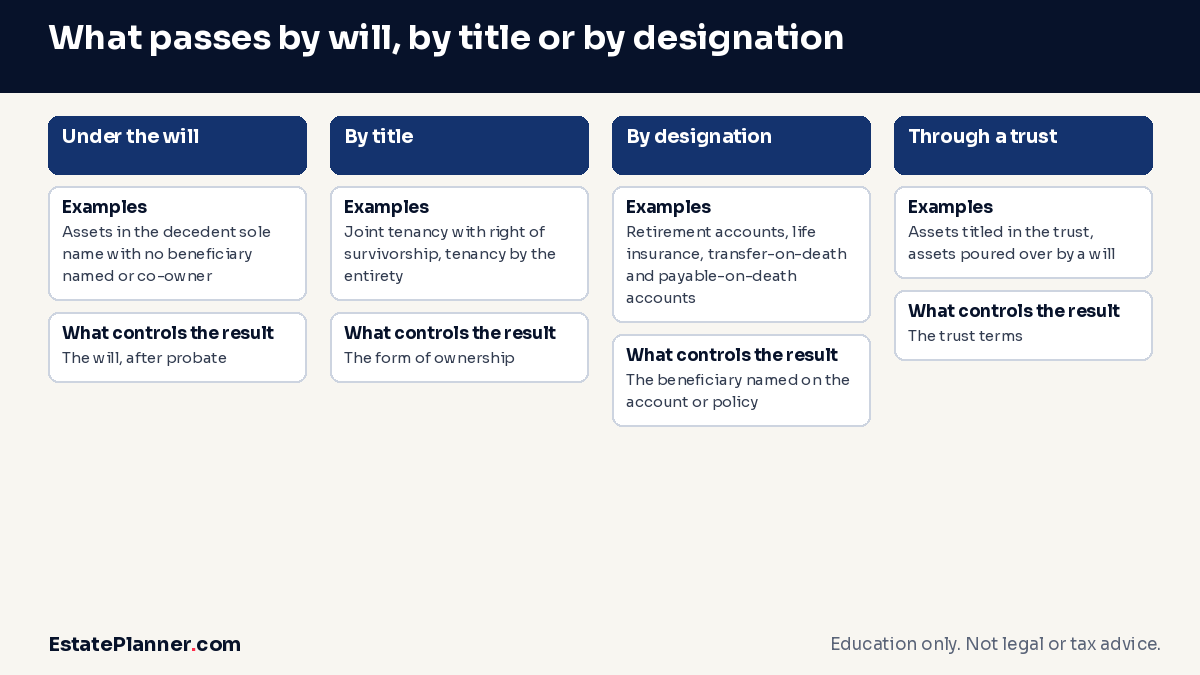
Bring the account agreement, current registration, relevant will language and any written notice to the institution. Ask counsel to examine those records together before relying on an account label alone. For a visual discussion aid, see what passes by will, by title or by designation.
Reviewing designations and trust instructions
Preparing the will and trust documents
Read the pour over will entry alongside the will and receiving trust instrument. Bring amendments and any termination documents to the drafting attorney. Ask how the proposed transfer is structured.
The trust creation answer below addresses a transfer to a trustee under a will. Review that answer before comparing the proposed trustee, beneficiaries and instructions.
An owner with several kinds of property
For a business owner or investor, organize a document packet for each holding. Put the business ownership records and operating agreement together, the real estate deed with the property records, and the brokerage registration with the account agreement. Write down the intended recipient and any separate management question.
Use the LLC transfer answer below to prepare questions about distribution rights and management. Bring a list of gifts and available assets for the gift reduction discussion.
Preparing questions about probate and estate tax
Bring ownership and contribution records to counsel and the tax adviser. Ask separately about the transfer of each asset, estate administration and federal estate tax valuation.
State definitions and transfer provisions
Washington's definition
In Washington, unless context requires otherwise, the definition of nonprobate assets for the relevant statutory title covers beneficial rights and interests passing at death under a written instrument or arrangement other than the person's will.
Examples include joint tenancy and joint bank account survivorship interests, transfer on death deeds, payable on death or trust bank accounts, and transfer on death securities or securities accounts. The definition also includes individual retirement accounts or bonds and specified trusts that become effective or irrevocable only at the grantor's death.
The definition excludes specified insurance, annuity and employee benefit provisions, rights passing by descent and distribution, and rights irrevocably transferred before death. The exclusions also cover rights subject to the specified waived transfer powers or unilateral contractual modification powers, and rights held solely as a fiduciary.
Separate definitions apply to divorce revocation and testamentary disposition of nonprobate assets. These exclusions do not establish probate treatment. Other states differ.
The Arizona answer below provides a separate example. For further state research, continue through the state guides.
| Review topic | Documents to bring | Discussion on this page |
|---|---|---|
| Will and administration | Signed will and appointment papers | Questions about probate and the executor |
| Account ownership | Account agreement, registration and relevant notices | Questions about account ownership |
| Insurance designation | Coverage records, designation and relevant court instruments | The federal insurance designation answer |
| Trust instructions | Will, trust instrument and amendments | Preparing the will and trust documents |
| Business interest | Ownership records and operating agreement | Distributions and management |
Common questions
Does Minnesota law specify an order for reducing gifts?
Yes. In Minnesota, for example, the default abatement order begins with property not disposed of by will, followed by residue, general gifts and specific gifts. There is no preference between real and personal property.
Within each class, reduction is proportional to what each beneficiary would have received on full distribution. A general gift charged against specific property is treated as specific up to that property's value and general for any shortfall.
The surviving spouse's elective share rules are excepted. A stated abatement order, or a testamentary plan or purpose that the default would defeat, changes the result as needed to carry out the testator's intent.
If a preferred gift is sold or used during administration, appropriate adjustments or contributions from remaining interests are required. Other states differ. Bring the gift instructions and available asset records to counsel for review.