
What passes by will, by title or by designation
Key takeaway
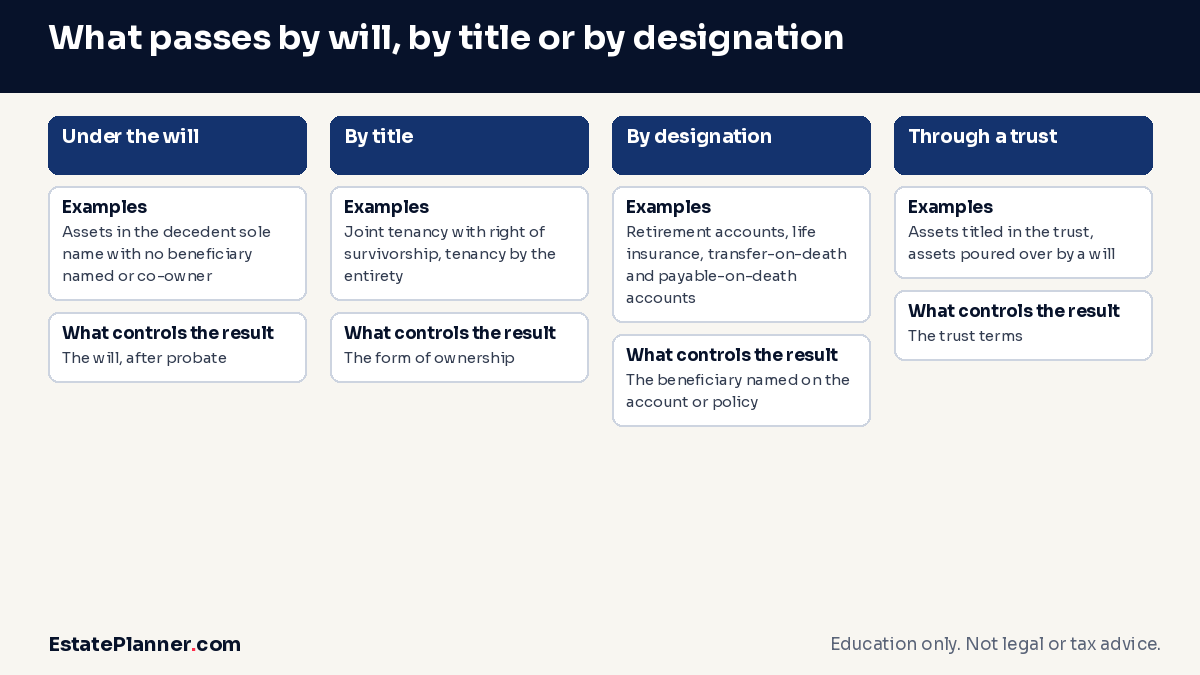
Property may pass by will or intestacy, survivorship title, beneficiary designation or trust terms, subject to applicable law and documents. A gift to a trust through a will still passes through probate.
Start with one asset at a time. Gather its ownership record, any beneficiary designation, the will and any trust documents. Use the examples below to frame questions about those records.
Property passing by will or intestacy
In Minnesota, for example, property devised by will remains subject to estate administration, creditors, statutory allowances, the surviving spouse’s elective share and restrictions under the homestead and descent statutes. Other states differ.
In Minnesota, for example, property not disposed of by will passes to heirs under intestacy law after spousal and family allowances. A will may expressly exclude an heir. Other states differ.
Property passing by survivorship title
In Wisconsin, when one of two joint tenants dies, the survivor becomes sole owner. When one of three or more dies, the survivors remain joint tenants of the entire interest.
Wisconsin survivorship is governed by its statutory survival requirements. A survivor’s statutory disclaimer severs the disclaimed interest as of death. If one joint tenant unlawfully and intentionally kills another, the state’s slayer statute governs the deceased tenant’s interest.
For your review, bring the actual deed or ownership agreement rather than relying on a description such as “jointly owned.”
Property passing through a payable on death account
In Minnesota, for example, remaining POD account deposits belong to surviving POD payees when the original party, or last surviving original party, dies. Other states differ.
If several payees survive, they have no subsequent survivorship between themselves unless the account or deposit agreement expressly provides it.
A will specifically referring to the account can change POD survivorship. The institution is bound only after written notice of the claim. It then must leave the deposit undisbursed until a probate court order adjudicates the decedent’s interest disposable by will.
Transfers under Minnesota’s account survivorship statute operate through the account contracts and statute outside probate, except transfers expressly changed by will under clause (d).
When other estate assets are insufficient, these transfers cannot defeat debts, taxes, administration expenses, statutory family allowances or authorized state or county claims under the specified medical assistance recovery statute.
This limit applies to the extent the decedent was the source or beneficial owner of the funds. Other states differ.
Retirement and insurance beneficiary designations
For ERISA covered benefits, fiduciaries follow governing plan documents insofar as those documents comply with ERISA. In Kennedy, the particular plan documents directed payment to the designated beneficiary and prescribed how designations and changes were made.
Pension plans must also pay benefits in accordance with applicable requirements of a qualified domestic relations order. Read the plan documents alongside the designation when preparing questions about employer benefits.
An IRA owner may choose a person or entity to receive IRA benefits after death. Beneficiaries of a traditional IRA must include taxable distributions they receive in gross income.
In Minnesota, for example, when life insurance is effected in favor of another person, that beneficiary is entitled to the proceeds against the creditors and representatives of the person effecting the insurance. Other states differ.
Premiums paid in fraud of creditors, with interest, benefit those creditors from the proceeds if the insurer receives specific written notice before payment.
Property administered under trust terms
In Minnesota, for example, after accepting trusteeship, a trustee must administer trust property in good faith according to the trust’s terms and purposes, beneficiaries’ interests, the trust chapter and all other applicable law. Other states differ.
Compare the trust document with the ownership records for each asset. Keep a separate question list for property already held in trust and property intended as a gift through the will.
Two related terms
Pour over will
In Minnesota, for example, this will leaves probate property to an identified trust whose terms are in a separate written instrument, executed before, with or after the will, even if unfunded, although other states differ.
The gift passes through probate and becomes part of that trust rather than a testamentary trust, but lapses if the trust is revoked or terminated before death unless the will provides otherwise.
Trust funding
In Minnesota, for example, trust creation methods include transferring property to a trustee during life, by will or another disposition effective at death, or declaring that the owner holds identifiable property as trustee, although other states differ.
Signing trust terms alone does not establish that every asset belongs to the trust, and legal estates and interests outside an express trust and not otherwise disposed of remain in the settlor.
Perspective on getting knowledgeable help
"Now, I want to caution everyone watching this today, you have to know what you're talking about. You cannot dabble in the strategies that I'm about to discuss. It does take some work or in the beginning, you could partner with someone that knows what they're talking about."
Common questions
Can a will revoke a transfer on death deed?
In Minnesota, for example, a will does not revoke a transfer on death deed executed, acknowledged and recorded in accordance with the state’s TOD deed statute. Other states differ.
What if no securities beneficiary survives the owners?
In Minnesota, for example, TOD registered securities belong to the sole owner’s estate, or the last surviving owner’s estate, if no beneficiary survives all owners. Other states differ.
Does a will recipient’s name remove competing statutory rights?
No. In Minnesota, for example, the restrictions described under “Property passing by will or intestacy” still apply to property devised by will. Other states differ.
Sources
- Minnesota §524.3-101: devolution, administration and statutory rights. Includes the restrictions in §§525.14 and 524.2-402.
- Minnesota §524.2-101: intestacy and exclusion of heirs.
- Wisconsin §700.17: joint tenancy. Includes references to §§854.03(2), 854.13(2)(b) and 854.14.
- Minnesota §524.6-204: POD accounts and changes by will under clause (d).
- Minnesota §§524.6-206 and 524.6-207: probate exception and creditor limits. Includes state or county claims authorized by §256B.15.
- ERISA plan document duties, 29 USC §1104.
- Kennedy v. Plan Administrator for DuPont: the particular plan documents.
- ERISA qualified domestic relations orders, 29 USC §1056.
- IRS Publication 590 B: IRA beneficiaries and taxable distributions.
- Minnesota §61A.12: life insurance proceeds and fraudulent premiums.
- Minnesota §501C.0801: trust administration.
- Minnesota §524.2-511: gifts to an identified trust.
- Minnesota §501C.0401: trust creation and retained interests.
- Minnesota §507.071: transfer on death deeds.
- Minnesota §524.6-307: TOD securities when no beneficiary survives.