
How probate administration and executor authority work
Key takeaway
Estate administration involves inventory, creditor notice, claims, required tax returns, distribution and closing. The Minnesota example below explains representative powers and their limits. Other states differ.
Research notice: Based on primary sources linked below. Minnesota examples draw on Chapter 524 and the session law linked in Sources. Federal discussions draw on IRS Publication 559 and the federal priority statute. Ask an estate attorney or CPA to confirm authority, notice requirements, deadlines, proposed transactions and tax filings for the estate.
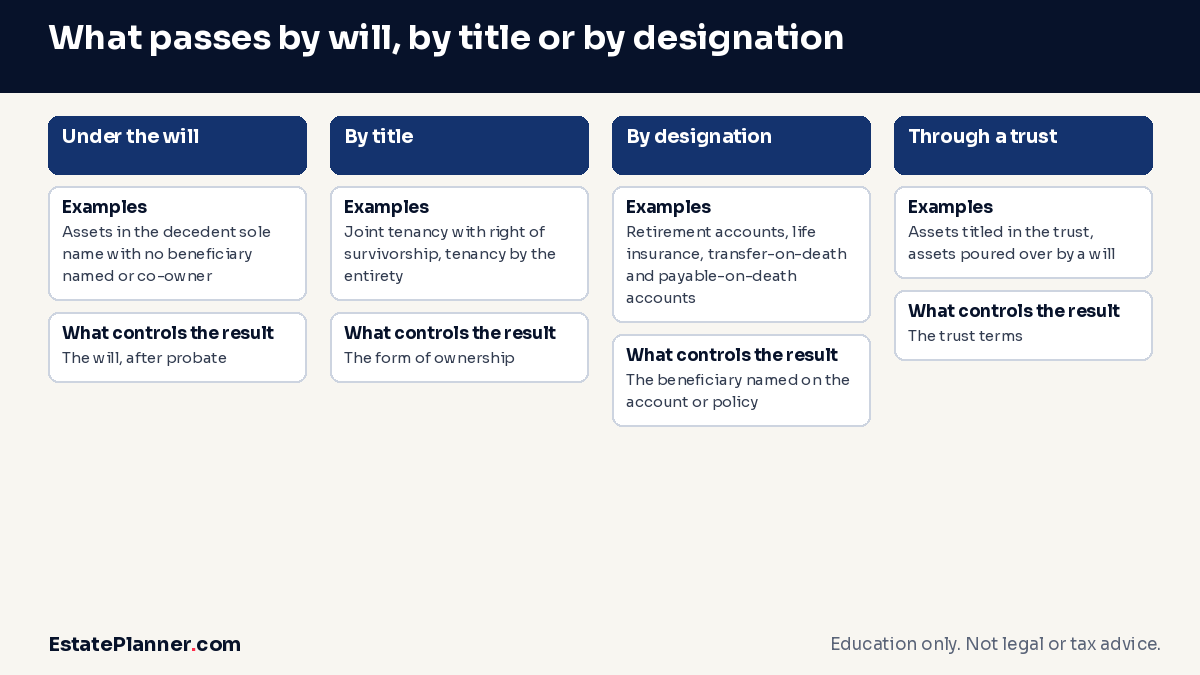
Use the sections below to examine representative authority, inventory, creditors, court supervision, business decisions and closing. For trust arrangements, consult the trust guides. For ownership arrangements and beneficiary registrations, consult the joint ownership and transfer on death guide.
When representative authority begins
In Minnesota, for example, representative duties and powers begin upon appointment. Earlier acts by the person subsequently appointed receive the same effect as later acts when they benefited the estate. Before appointment, a person named executor in a will may carry out the decedent's written instructions about the body, funeral and burial arrangements. A representative may ratify and accept another person's acts on behalf of the estate only if those acts would have been proper for a representative. Other states differ.
Identify actions taken before appointment so counsel can review them separately from proposed future transactions. Use the authority review question below to prepare the documents for that discussion.
Questions about proving a will
For questions about proving a will, start with the wills and probate guides. Bring the will and any probate orders to counsel for review.
Inventory, creditor notice and claims
Inventory and values
In Minnesota, for example, the representative must prepare and file or mail an inventory within six months after appointment or nine months after death, whichever is later. This duty excludes special administrators and successors whose predecessors already discharged it. The inventory lists property owned at death in reasonable detail, each item's fair market value at death, and each encumbrance's type and amount. Copies must be mailed or delivered to the surviving spouse, all residuary distributees, and interested persons or creditors who request them. A representative need not receive a separate personal copy as spouse or residuary distributee. Other states differ.
In Minnesota, for example, qualified and disinterested appraisers may assist with an asset's fair market value at death when its value is reasonably doubtful. Different appraisers may value different asset types. The inventory identifies each appraiser's name and address with the items appraised. Newly discovered property or an erroneous or misleading inventory value or description requires a supplementary inventory or appraisal. The supplement states the new or revised market value at death or description and identifies any appraisers or other data relied upon. Copies or information go to persons interested in the new information, and the supplement must be filed if the original inventory was filed. Other states differ.
Keep ownership records, value information and encumbrance documents together for the inventory review. Flag assets discovered later and entries that may need correction.
Creditor notice
In Minnesota, for example, unless notice was already given, publication follows informal appointment of a general representative or filing a petition for formal appointment of a general representative. Under the court administrator's direction, notice in the form prescribed by court rule appears once weekly for two successive weeks in a legal newspaper in the county of the proceeding. Within three months after first publication, the representative must serve then known and identified creditors, subject to the exceptions below. Other states differ.
In Minnesota, for example, known creditors include creditors whose asserted lifetime claims are known to the representative or clearly disclosed in accessible financial records known and available to the representative. They also include creditors whose claims would be revealed by a reasonably diligent search of those records. A creditor is identified when the representative's knowledge of the name and address permits service. Individual service is unnecessary for claims already presented or paid. Permitted service includes delivery or certified, registered or ordinary first class mail addressed to the creditor's office or residence. Other states differ.
In Minnesota, for example, if the decedent or a predeceased spouse received assistance supporting claims under sections 246.53, 256B.15, 256D.16 or 261.04, separate agency notice under paragraph (d) applies instead of ordinary creditor service. Notice goes to the commissioner of human services or Direct Care and Treatment executive board, as applicable. Other states differ.
Use the official creditor notice text with counsel for agency notice procedures. Keep publication and individual service records available when reviewing deadlines.
Creditor deadlines and exceptions
In Minnesota, for example, predeath claims not already barred by another limitation statute have different deadlines according to the notice entitlement and notice received. Creditors constitutionally entitled only to publication have four months after the date of the court administrator's notice subsequently published. Individually served creditors have the later of four months after first publication or one month after service. The statute also provides a deadline of one year after death whether or not notice was given. Claims under sections 246.53, 256B.15 and 256D.16 are excluded from that one year bar. Other states differ.
In Minnesota, for example, postdeath claims based on a contract with the representative have four months after the representative's performance is due. Other postdeath claims have four months after arising. The statute preserves proceedings to enforce mortgages, pledges and other liens on estate property. It also preserves proceedings to establish liability of the decedent or representative protected by liability insurance, only to the limits of that insurance. Other states differ.
In Minnesota, for example, exceptions permit presentation and payment of predeath claims referred to in section 524.3-715, clause (18), within one year after death despite another bar under the creditor deadline statute. Postdeath claims within that clause may be presented and paid before a petition under section 524.3-1001 or section 524.3-1002, or a closing statement under section 524.3-1003, is filed. Before that closing filing, other claims otherwise barred under the creditor deadline statute may be allowed for cause on petition by the representative or claimant, with notice and hearing as the court directs. Other states differ.
Bring the claim, its origin, the relevant performance date and the notice records to the deadline review. Review the applicable claim category and exceptions with counsel before relying on a calendar date.
Insufficient assets and payment priorities
In Minnesota, for example, statutory payment classes apply when applicable estate assets cannot pay every claim in full. Other states differ. Federal law separately gives United States claims priority when a deceased debtor's estate in the executor's or administrator's custody cannot pay all debts. That federal priority does not apply in a case under title 11.
A representative who pays another debt before a United States claim may be personally liable for the unpaid federal claim to the extent of that payment. The federal liability provision excludes a trustee acting under title 11. For tax liabilities, IRS Publication 559 describes personal responsibility for a representative of an insolvent estate who had notice of the tax obligations or failed to exercise due care in identifying them before distribution and discharge. Responsibility extends to other payments made before federal debts, except payments of debts having priority over federal debts.
Ask counsel to review payment priorities before authorizing payments from an estate with insufficient assets. Use the linked authorities for the payment classes.
Federal tax returns
The personal representative must file required returns for the decedent and estate when due. IRS Publication 559 separately discusses the decedent's final individual income tax return, the estate's income tax return and the estate tax return. Probate closing does not establish that a required federal filing has been satisfied.
Use the estate and revocable trust income tax guide for income tax questions. Use the federal estate, gift and GST tax guides for detailed filing thresholds, elections and related tax questions.
Questions about small estate procedures
For small estate and simplified procedure questions, consult the small estate and simplified probate procedures guide. Take the complete property list and appointment history to counsel before selecting a procedure.
What court supervision can look like
In Minnesota, for example, a representative ordinarily must proceed expeditiously with settlement and distribution without obtaining an order for every act. The representative may seek court resolution of administration questions through proceedings authorized by the chapter. Supervised administration may impose additional requirements. Unless restricted by the court, a supervised representative retains statutory powers without interim orders approving each exercise, but every estate distribution requires a prior court order. Other restrictions must be endorsed on the letters to affect persons dealing in good faith with the representative. Other states differ.
Review the appointment documents, letters and any later orders together before discussing a proposed transaction. For distribution and closing questions, continue to the distribution section.
Property, business, conflicts and corepresentatives
Retaining, repairing and selling property
In Minnesota, for example, a representative acting reasonably for the benefit of interested persons may retain assets pending distribution or liquidation, repair buildings, insure estate assets, and sell, mortgage or lease estate property. These powers remain subject to restrictions or other provisions in the will, orders in formal proceedings and the priorities stated in section 524.3-902. The sale, mortgage or lease power does not dispense with consent when property was specifically devised. If the spouse takes any interest in the homestead, its sale, mortgage or lease requires the spouse's written consent. Other states differ.
Put the proposed transaction beside the will, any formal orders and the property's ownership records. Identify any specific devise and any spouse's homestead interest for the attorney reviewing the transaction.
Continuing an unincorporated business
In Minnesota, for example, a representative may continue an unincorporated business or venture in which the decedent was engaged at death in the same form for up to four months after appointment of a general representative. Continuation must reasonably preserve business value, including goodwill. The representative must act reasonably for the benefit of interested persons, subject to restrictions or other provisions in the will, orders in formal proceedings and the priorities stated in section 524.3-902. Further continuation in the same form requires a court order in a formal proceeding with interested persons as parties. Continuation throughout administration through incorporation requires that no competent adult probable distributee of the business object to incorporation and retention in the estate. Other states differ.
Bring business agreements and the proposed continuation plan to counsel with the appointment records. Identify whether the proposal concerns temporary continuation, a longer period in the same form or incorporation.
Conflicts of interest
In Minnesota, for example, a transaction affected by the representative's substantial conflict of interest is voidable by an interested person, subject to the exceptions below. Covered transactions include sales or encumbrances to the representative, spouse, agent or attorney, or a corporation or trust in which the representative has a substantial beneficial interest. A person who consented after fair disclosure cannot avoid the transaction under this provision. Exceptions apply if the will or the decedent's contract expressly authorized it, or the court approved it after notice to interested persons. Other states differ.
Identify the proposed buyer, lender or other counterparty and any connection to the representative before the transaction review. Include any claimed authorization, disclosures, consents and court approval in the discussion.
Acting with corepresentatives
In Minnesota, for example, when two or more corepresentatives are appointed, all ordinarily must concur in administration and distribution acts unless the will or court provides otherwise. Concurrence is unnecessary for receiving and receipting for estate property, necessary emergency preservation when concurrence cannot readily be obtained in the time reasonably available, or action delegated by the others. Other states differ.
Review the will, appointment order and any delegation before assigning responsibility for a proposed act.
How administration ends in distribution
Residuary distribution and recovery
In Minnesota, for example, unless the will indicates a contrary intention, the residuary estate is distributed in kind when nobody objects to the proposed distribution and distributing undivided interests is practicable. Otherwise, residuary property may be converted to cash for distribution. Other states differ.
In Minnesota, for example, a claimant or distributee improperly paid who still holds the property must return it and its income since distribution. A recipient who no longer holds it must return its value at disposition plus income and gain received. Recovery is unavailable when adjudication, estoppel or limitation prevents questioning the payment or distribution. Other states differ.
Bring the proposed distribution and any objections to the review. Consult counsel for distribution valuation and allocation procedures.
Closing by statement
In Minnesota, for example, closing by statement is unavailable in supervised administration or when prohibited by court order. Filing must be no earlier than four months after original appointment of a general representative, and first creditor publication must have occurred more than four months before filing. The representative or a predecessor must have completed administration, inventoried the assets and distributed them to the persons entitled. Presented claims, administration expenses and estate and other taxes must have been paid, settled or otherwise disposed of, except as specified in the statement. Outstanding liabilities require detailed arrangements in the statement. Other states differ.
In Minnesota, for example, before filing, the representative must send the statement to all distributees and creditors or known claimants whose claims are neither paid nor barred. A full written account must go to distributees whose interests are affected. If no proceedings involving the representative are pending in the court one year after filing, the appointment terminates. Letters remain effective until one year after filing, when authority terminates. These conditions do not promise a completion timetable. Other states differ.
Review the inventory, distributions, outstanding liabilities, account and required recipients together before preparing the closing statement. Revisit the federal tax return discussion separately with the tax adviser.
Common questions
What should I bring to an authority review?
Bring the will, any appointment order, letters already issued and a record of actions taken before appointment. Read when representative authority begins to prepare questions about the Minnesota example.
What tasks are part of estate administration?
Estate administration tasks include inventory, creditor notice, claims review, required tax returns, distribution and closing. Start with inventory, creditor notice and claims, then review federal tax returns and distribution and closing for the applicable conditions.
How does a trust affect administration tasks?
A trust is handled separately from this Minnesota representative example. Consult the trust guides for trust arrangements and use the authority discussion for the estate representative example.
Resources to check out
- IRS Publication 559: Survivors, Executors, and Administrators: Federal tax guidance for readers handling a decedent's affairs.
- Minnesota Statutes: Notice to Creditors: Official text for the creditor notice discussion.
- Minnesota Statutes: Supervised Administration Powers: Official text for the supervised administration distinction.
- Minnesota Statutes: Closing Estates by Statement: Official text for closing conditions and accounting.
Reading for a Wisconsin estate
Wisconsin Court System: Guide to Informal Estate Administration: A Wisconsin resource for readers researching that state's administration forms and workflow.