
How revocable living trusts work and what they do not do
Key takeaway
A revocable living trust can avoid probate for property transferred to it, but estate tax inclusion and administration remain separate issues.
Start with three questions: What property has entered the trust? Who can manage it if you cannot? What work will remain after your death?
The trust must receive the property
The trustee has authority only over money and property transferred to the trust. Signing the trust document does not give the trustee authority over property left outside it.
Compare your property list with your trust records. For deeds, account transfers, business interests and property in several states, use the funding guide below.
Management during incapacity depends on the successor's authority
A successor trustee acts when the current trustee can no longer fulfill the role, including because of death or disability. That authority covers trust property only.
Review who is named to take over and where that person will find the trust document and property records. The guide on control during incapacity below covers this topic.
Probate avoidance does not remove federal estate tax inclusion
Property subject to the decedent's power to alter, amend, revoke or terminate is included in the federal gross estate when that power is held at death, alone or with another person.
Inclusion also applies when such a power was relinquished during the three years before death. A bona fide sale for adequate and full consideration is excepted.
Keep the probate question separate from the tax question when reviewing the plan with your advisers.
Administration continues after funding
A trustee receiving or holding revocable trust property included in the decedent's gross estate at death can be personally liable for estate tax unpaid when due, up to that property's value at death.
In Minnesota, for example, trustees must keep adequate administration records and keep trust property separate from their own property. Other states differ.
Minnesota permits investing property of separate trusts together only while records clearly identify each trust's respective interest. That permission does not allow mixing trust property with the trustee's own property.
In Minnesota, for example, an event terminating all or part of a trust requires expeditious distribution to those entitled to the property. Other states differ.
The trustee may retain a reasonable reserve for debts, expenses and taxes and secure reimbursement if the reserve proves inadequate. This distribution requirement is triggered by termination, rather than death alone.
Two related terms
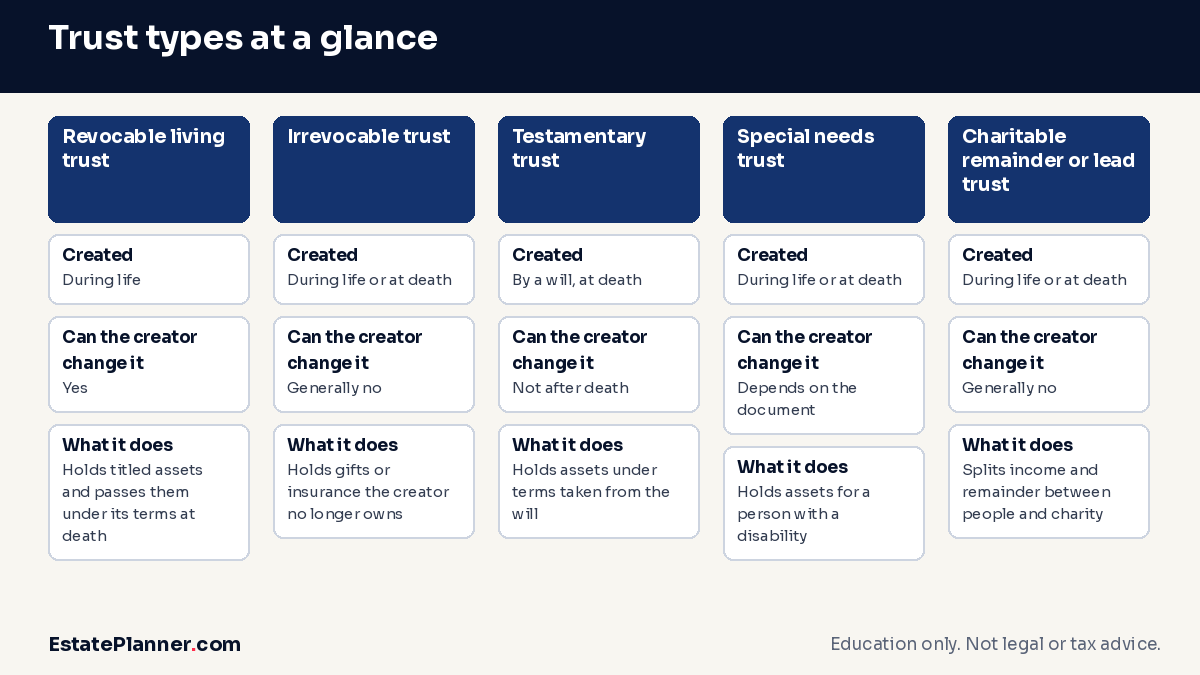
Irrevocable trust: A trust that generally cannot be revoked unilaterally by its settlor. Modification or termination may be available under its terms or state law.
Spendthrift provision: A provision restricting a beneficiary's transfer of an interest and creditors' access to it, subject to state law requirements and exceptions.
A perspective on finishing the work
One speaker described the gap between receiving a trust document and completing the work:
"that trust many state planning attorneys will create it for you and say here it is put everything in it and then they say goodbye after you pay them their bill sorry I hope there're no estate planing attorneys or anything but that's not the whole job"
Common questions
Does a revocable trust protect my property from my creditors?
No, in Minnesota, for example, revocable trust property remains subject to the settlor's creditors during the settlor's lifetime, whether or not the trust includes a spendthrift provision. Other states differ.
Does avoiding probate prevent trust litigation?
No, in Minnesota, for example, court proceedings involving a trust may include requiring an accounting or redressing a breach of trust. Other states differ.
Can an agent amend or revoke a trust during the settlor's incapacity?
In Minnesota, for example, an agent may exercise revocation, amendment or distribution powers only to the extent expressly authorized by the trust or, if it is silent, by a qualifying power of attorney. Other states differ.
The alternative power of attorney must expressly authorize those powers and cannot be the statutory short form under Minnesota's short form statute. A conservator needs approval from the court supervising the conservatorship.
Does a pour over will avoid probate for property left outside the trust?
No. In Florida, a pour over will must be admitted to probate to pass title to probate property devised to the trustee.
The written trust must exist when the will is made or be signed at the same time, and the will must identify it. Other states' rules differ.
The devise remains valid if the trust is revocable or later amended, but fails if the trust is entirely revoked in writing before death. Unless the will provides otherwise, the property becomes principal of the receiving trust.
Sources
- Consumer Financial Protection Bureau: What is a revocable living trust?. Trust funding, trustee authority and successor trustees.
- Internal Revenue Code §2038. Gross estate inclusion for retained powers and the adequate consideration exception.
- Internal Revenue Code §6324(a)(2). Personal liability for unpaid estate tax.
- Minnesota Trust Code. Sections 501C.0202, 501C.0505, 501C.0810 and 501C.0817 address court proceedings, creditor claims, records and distributions.
- Minnesota Statutes §501C.0602. Agent and conservator authority, including the exclusion for the statutory short form under §523.23.
- Florida Statutes §732.513. Devises to trustees and the conditions governing them.
- Florida Statutes §733.103. Probate admission and proof of title under a will.