How executor authority and responsibilities work
Key takeaway
An executor named in a will generally has no authority to act until the court admits the will to probate and issues letters. That authority covers the probate estate. Assets that pass by beneficiary designation, survivorship or trust generally pass outside the will and outside the executor's administration.
What estate administration is
A speaker defines estate administration as the process of winding up a person's financial dealings after death and then distributing that person's property to the people who inherit it.
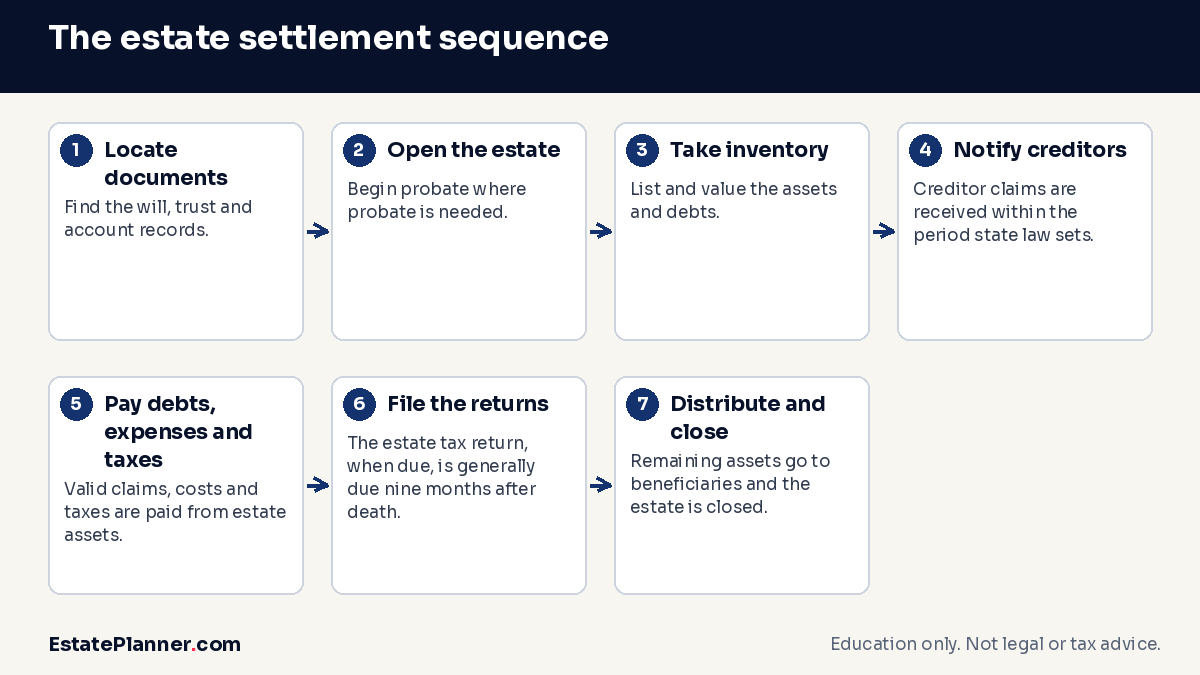
Practitioners describe the executor's duties as gathering assets, paying liabilities, filing tax returns and funding trusts, usually with help from an attorney or accountant. Executors are typically family or friends, and sometimes a bank or trust company in complex estates.
When authority begins
In New York, a person named executor in a will has no authority to act until the Surrogate's Court admits the will to probate and issues letters testamentary.
Authority derives from state law. The Tax Court held that a successor trustee could not represent a decedent's estate in Tax Court without authority derived under state law.
Rule 60(c) requires the Tax Court to determine a fiduciary's capacity to litigate under the law of the jurisdiction from which the authority comes.
Who may be appointed
D.C. Code section 20-303 sets the priority for appointing a personal representative. It starts with the will-named representative, then the surviving spouse or domestic partner, and children if the decedent died intestate. It then turns to residuary legatees, children and grandchildren.
When several people in a priority class are eligible, the court may grant letters to one or more as convenient. All representatives named in a probated will are entitled to letters.
For federal estate tax purposes, if no executor or administrator has been appointed, qualified and is acting in the United States, the term executor includes a person in actual or constructive possession of the decedent's property.
What the executor controls
Authors say accounts titled in a decedent's name are typically frozen after death until institutions receive documents establishing who may act.
Duties and standards of care
Alaska law says a personal representative is a fiduciary who must observe trustee standards of care and must settle and distribute the estate under any probated and effective will and applicable law.
Arkansas law treats an executor as a fiduciary who must act in good faith in estate transactions and cannot put personal interests ahead of heirs.
Tax filings and fiduciary status
The IRS says a fiduciary seeking to act for a taxpayer before the IRS, or to report that the fiduciary capacity has ended, must file Form 56.
For IRS purposes, a fiduciary is treated as the taxpayer and assumes responsibility for required actions, including filing returns and paying taxes due.
Removal
An Arkansas court may remove a personal representative for incapacity, unsuitability, mismanagement, or failure to perform a legal or court-ordered duty.
Alaska law says a person interested in the estate may petition for removal of a personal representative for cause at any time, after which the court fixes a time and place for hearing.
The lawyer's role
In Florida, practitioners say the probate lawyer represents the personal representative, and not the estate's beneficiaries or creditors.
ACTEC says a lawyer representing a fiduciary generally assists with administration decisions, including distribution timing and available tax elections, unless the engagement limits that work.