
How the federal estate tax is calculated
Key takeaway
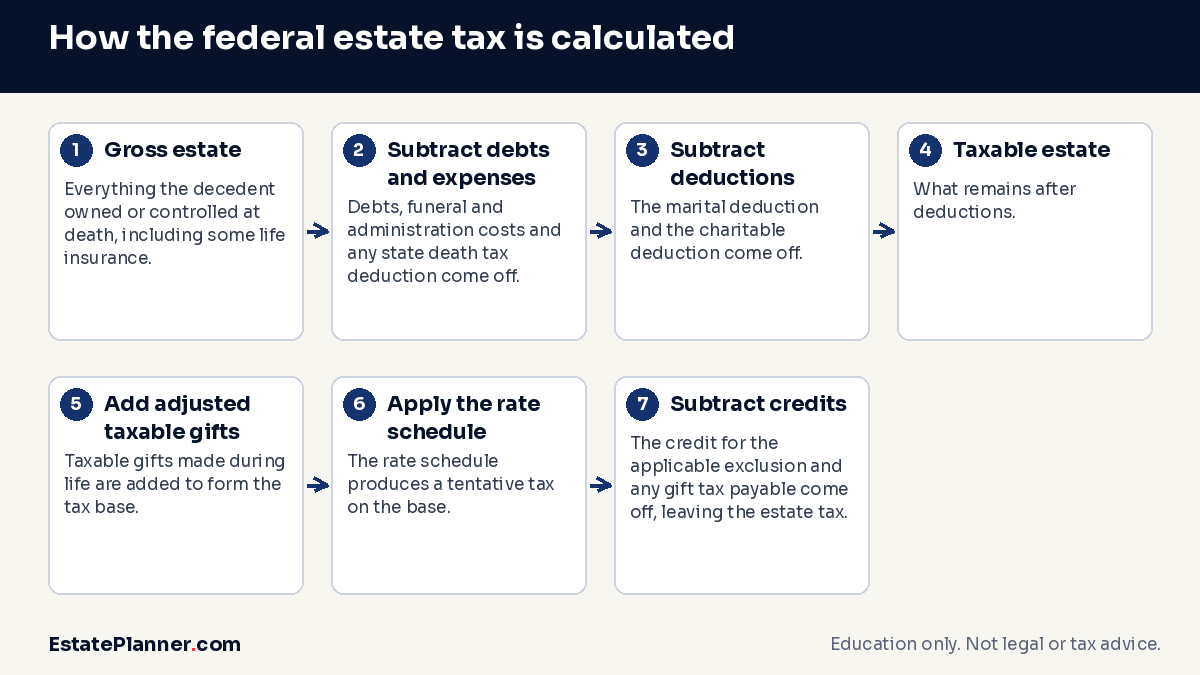
For a U.S. citizen or resident decedent, federal estate tax is calculated by subtracting allowable deductions from the gross estate, applying the rate schedule to the taxable estate plus adjusted taxable gifts, and subtracting recomputed gift tax payable and allowable credits.
What the chart shows
For a U.S. citizen or resident decedent, the calculation distinguishes the taxable estate from the amount used to compute tentative tax. The taxable estate is the gross estate less the deductions allowed by the statutory provisions governing the taxable estate.
The statutory calculation first determines tentative tax on the taxable estate plus adjusted taxable gifts, then takes the excess, if any, over recomputed gift tax payable before allowable credits are applied. The recomputation uses the estate tax rates effective at death for both gift tax and the gift tax credit, including the applicable credit amount and credits for preceding periods, with the spouse coordination adjustments explained below.
Read the flow from beginning to end, then use the matching table to review each stage. See Sources for the full definition of adjusted taxable gifts and the full applicable credit adjustment.
How to read the chart
The first part of the calculation establishes the gross estate and allowable deductions, producing the taxable estate. For a U.S. citizen or resident decedent, the taxable estate and adjusted taxable gifts then form the amount to which the tentative tax rate schedule applies.
Federal estate tax calculation flow
- Establish the gross estate. Review valuation, life insurance and the gift tax addition before carrying a gross estate amount forward. Use the gross estate glossary for further reading.
- Identify allowable deductions. Only deductions allowed under the statutory provisions governing the taxable estate reduce the gross estate for this purpose. For statutory expense and debt deductions and mortgage accounting, consult the federal estate, gift and GST tax guide. Review the charitable deduction and state death tax deduction under their conditions below.
- Determine the taxable estate. For federal estate tax purposes, subtract the deductions allowed under the applicable statutory part from the gross estate. The resulting amount is the taxable estate.
- Combine the taxable estate and adjusted taxable gifts. For a U.S. citizen or resident decedent, tentative tax is computed on their sum. See Sources for the full adjusted taxable gift definition and the split gift answer for spouse coordination.
- Compute tentative tax. For a U.S. citizen or resident decedent, apply the statutory rate schedule to the combined taxable estate and adjusted taxable gifts. Tentative tax precedes the statutory gift tax subtraction and allowable credits.
- Subtract recomputed gift tax payable. Use the rates effective at death to recompute gift tax and the gift tax credit, including the applicable credit amount and preceding period credits, and apply the spouse coordination rules below. The statutory result before credits is the excess, if any, of tentative tax over that recomputed amount.
- Apply allowable credits. See the applicable credit answer and Sources for the computation, tax limit and full credit adjustment. Review Schedule P for foreign death taxes and Schedule Q for prior transfers when relevant, because those reporting instructions alone do not establish eligibility for either additional credit.
Where owners see this in practice
Review the following questions when organizing property values, insurance records, gift tax records and state death tax payments. For other gross estate inclusion questions, consult the federal estate, gift and GST tax guide.
Which values enter the calculation?
Fair market value at death generally supplies the value of property included in the gross estate, subject to the alternate valuation method under §2032. Consult the federal estate, gift and GST tax guide for the alternate valuation election and its conditions.
Can life insurance enter the gross estate?
Yes. Insurance proceeds on the decedent’s life receivable by the executor enter the gross estate, as do proceeds payable to other beneficiaries when the decedent held incidents of ownership at death, exercisable alone or jointly with another person. A reversionary interest counts as an incident of ownership only if its value exceeded 5% of the policy’s value immediately before death.
Can gift tax paid before death increase the gross estate?
Yes. The gross estate includes gift tax paid under the federal gift tax provisions by the decedent or the estate on a gift made by the decedent or the decedent’s spouse during the three year period ending at death. The gross estate addition is separate from the recomputed gift tax payable subtraction later in the calculation.
Can state death taxes be deducted?
Yes. Qualifying estate, inheritance, legacy or succession taxes paid to a state or the District of Columbia because of the death, on property included in the gross estate, may be deducted without a dollar cap, subject to the payment and claim requirements. An anticipated deduction may be reported before payment, but final allowance requires payment and a deduction claim ordinarily within four years after filing the return. Later periods may apply if a petition is filed with the United States Tax Court, an extension of time to pay is in effect under §6161 or §6166, or a qualifying refund or credit claim extends the deduction deadline. Coordinated federal and state installment elections require review of the timing exceptions in §2058(b). If property other than cash pays a state inheritance tax, the deduction is limited to the lesser of the liability discharged or the property’s fair market value when transferred.
The data behind the chart
Use this table as the text companion to the flow. Follow the linked explanations for definitions and conditions before using an amount in a calculation.
| Stage | Calculation or review |
|---|---|
| 1. Gross estate | Review the practical questions, valuation, life insurance and the gift tax addition. |
| 2. Allowable deductions | Review the charitable deduction and state death tax deduction below, then follow stage 2 of the flow for further deduction reading. |
| 3. Taxable estate | The taxable estate for federal estate tax purposes equals the gross estate less deductions allowed under the applicable statutory part. |
| 4. Combined tentative tax base | For a U.S. citizen or resident decedent, tentative tax uses the sum of the taxable estate and adjusted taxable gifts. See Sources for the full adjusted taxable gift definition and review the spouse coordination rules. |
| 5. Tentative tax | For a U.S. citizen or resident decedent, when the combined taxable estate and adjusted taxable gifts exceed $1 million, tentative tax is $345,800 plus 40% of the excess over $1 million, before the gift tax subtraction and credits. Lower combined amounts require the other statutory rate brackets. |
| 6. Recomputed gift tax payable | Review the recomputation and both spouse coordination cases. |
| 7. Allowable credits | Review the exclusion and credit, Sources for the full credit adjustment, and additional credit schedules. |
Common questions
What is the tax base in the calculation?
For a U.S. citizen or resident decedent, tentative tax is computed on the taxable estate plus adjusted taxable gifts. The taxable estate itself is the gross estate reduced by the deductions allowed under the statutory provisions governing the taxable estate.
See Sources for the full definition of adjusted taxable gifts, including the cutoff and the exclusion for gifts included in the gross estate. Review the split gift answer for the spouse coordination adjustments.
How does the calculation reach the estate tax?
For a U.S. citizen or resident decedent, the statutory calculation takes the excess, if any, of tentative tax on the taxable estate plus adjusted taxable gifts over recomputed gift tax payable, then applies allowable credits. The gift tax recomputation uses the rates effective at death for gift tax and the gift tax credit, including the applicable credit amount and preceding period credits, with the spouse coordination adjustments described below.
Review the applicable credit answer, Sources for the full credit adjustment and the additional credit schedules before treating the calculation as complete.
Is the gift tax subtraction simply the gift tax historically paid?
No. The statutory subtraction recomputes gift tax payable using the estate tax rates effective at death for both gift tax and the gift tax credit, including the applicable credit amount and credits for preceding periods. The recomputation also requires the spouse coordination adjustments for split gifts described in the next answer.
Can split gifts change the calculation?
Yes. If the decedent made a gift, half was treated as the spouse’s gift under §2513, and the gift is included in the decedent’s gross estate, the spouse’s gift tax payable on that gift, determined under §2012(d), is treated as tax payable on a gift made by the decedent.
Conversely, if the spouse made the gift, half was treated as the decedent’s gift under §2513, and the gift is included in the spouse’s gross estate under §2035, exclude that gift from the decedent’s adjusted taxable gifts and reduce the gift tax payable subtraction by the amount, if any, determined under §2001(d) that was treated as tax payable by the decedent’s spouse with respect to that gift.
Does the upper bracket tax the entire gross estate at 40%?
No. For a U.S. citizen or resident decedent, when the combined taxable estate and adjusted taxable gifts exceed $1 million, the tentative tax is $345,800 plus 40% of the amount above $1 million, before the gift tax subtraction and credits. Combined amounts at or below $1 million require the other statutory rate brackets.
Is a bequest to charity deductible?
Yes. A bequest of property included in the decedent’s gross estate may qualify for the charitable deduction under §2055 if it passes to or for the use of a qualifying charitable corporation or association, or to the United States, a state, a political subdivision of a state or the District of Columbia exclusively for public purposes. The deduction can also apply to qualifying transfers made by the decedent during life.
A qualifying corporation or association must be organized and operated exclusively for religious, charitable, scientific, literary or educational purposes, including the encouragement of art, for the prevention of cruelty to children or animals, or to foster national or international amateur sports competition. An organization fostering amateur sports competition may not provide athletic facilities or equipment unless it is a qualified amateur sports organization. No part of net earnings may benefit a private individual, and no substantial activity may involve propaganda, attempts to influence legislation or participation in a political campaign on behalf of a candidate for public office.
Deduct only the amount actually available for charitable uses. Reduce the deduction for estate, GST, succession, legacy or inheritance taxes payable from the transfer. If estate tax installment interest is payable from property transferred to charity, reduce the deduction by an estimate of the maximum interest payable on the deferred tax. For a trust or pooled income fund in which charity receives only part of the interest, do not deduct the entire transfer merely because charity receives a part. Consult the federal estate, gift and GST tax guide before claiming a charitable deduction for such a transfer.
How does the exclusion relate to the credit?
The applicable exclusion amount is the amount used to compute tentative tax under §2001(c) for the applicable credit, subject to the §2001 tax limit and the specific exemption adjustment detailed in Sources. The credit cannot exceed the §2001 tax.
See Sources for the full credit adjustment, including the 20% reduction for the former §2521 specific exemption and its gift cutoff. For exclusion amounts, portability and GST exemption questions, consult the federal estate, gift and GST tax guide.
Are there credit schedules beyond the applicable credit?
Yes. The Form 706 instructions direct reporting of the foreign death tax credit from Schedule P and the credit for tax on prior transfers from Schedule Q. Reporting instructions alone do not establish eligibility or authorize either credit without the applicable schedule computation.
Sources
Adjusted taxable gifts are taxable gifts within the meaning of section 2503 made by the decedent after December 31, 1976, excluding gifts included in the decedent’s gross estate. Use taxable gifts rather than every lifetime transfer, and apply the spouse coordination rules in the split gift answer.
The applicable credit equals tentative tax under section 2001(c) computed on the applicable exclusion amount, subject to the tax limit and specific exemption adjustment. The credit cannot exceed the section 2001 tax and must be reduced by 20% of the aggregate amount allowed as a specific exemption under former section 2521 with respect to gifts made by the decedent after September 8, 1976.
- IRC §2001: Imposition and rate of tax. Review the computation, adjusted taxable gift definition, rate schedule and spouse coordination provisions.
- IRC §2010: Unified credit against estate tax. Review the applicable credit computation, tax limit and former specific exemption adjustment.
- IRC §2032: Alternate valuation. Consult the election provisions alongside the guide’s valuation discussion.
- IRC §2035: Adjustments for certain gifts made within 3 years of decedent’s death. Review the gift tax addition discussed above.
- IRC §2042: Proceeds of life insurance. Review the executor, ownership and reversionary interest provisions.
- IRC §2051: Definition of taxable estate. Read the definition used in stage 3.
- IRC §2058: State death taxes. Review the payment and deduction timing provisions.
- IRC §2503: Taxable gifts. Consult the taxable gift provision referenced by the adjusted taxable gift definition.
- Treasury regulation: Definition of gross estate and valuation of property. Review the valuation provision used above.
- IRS: Instructions for Form 706. Consult the deduction instructions and credit schedules discussed in the calculation.