
How the federal estate and gift tax system works
Key takeaway
The federal system taxes lifetime gifts and transfers at death, links gift and estate taxes through a shared exclusion, and provides a separate exemption for generation skipping transfers.
Lifetime gifts and exclusions
Federal gift tax applies to gifts of property wherever situated by U.S. citizens and residents, subject to exclusions and deductions. For gift tax, residence means domicile at the time of the gift.
A transfer by an individual for less than adequate and full consideration is a gift to the extent the property's value exceeds that consideration.
The annual exclusion covers qualifying present interest gifts up to the applicable limit, separately for each donor, each recipient and each calendar year. Future interests do not qualify. A separate annual limit applies to present interest gifts to a spouse who is not a U.S. citizen, only when the gift would qualify for the marital deduction if the spouse were a citizen.
Tuition paid directly to a qualifying educational organization for someone's education or training, and medical care payments made directly to that person's provider, are qualified transfers. They are not gifts for gift tax purposes and fall outside the annual exclusion.
The taxable estate and the shared exclusion
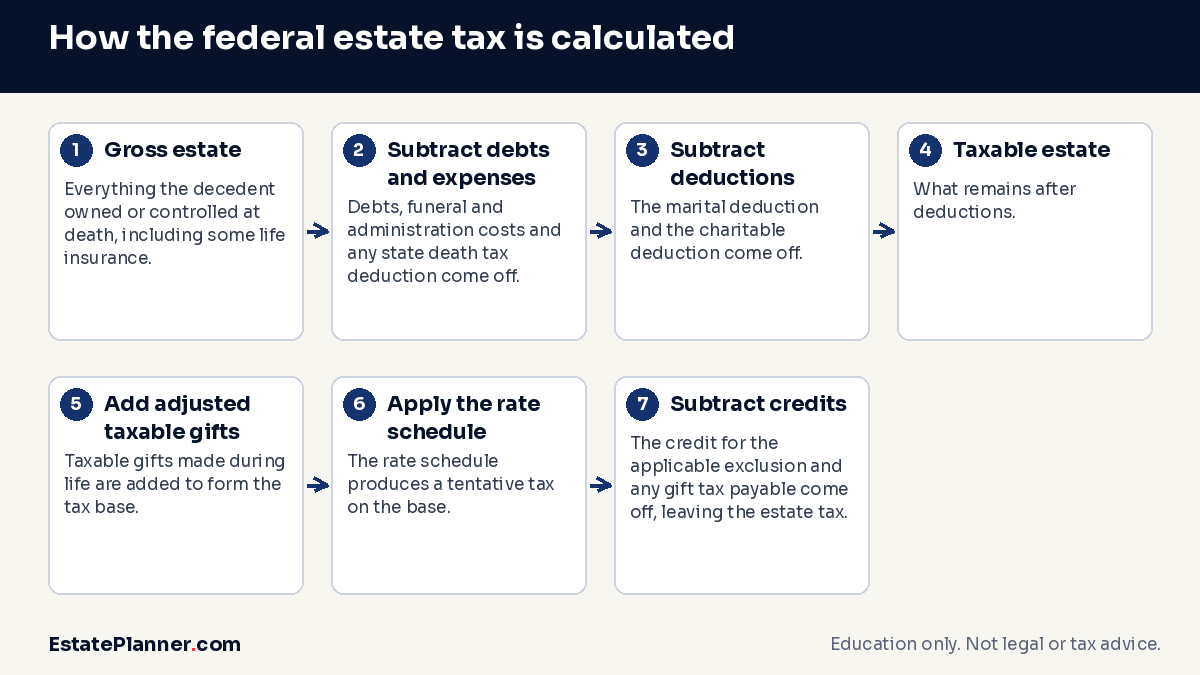
The taxable estate is the gross estate minus the deductions allowed by the estate tax deduction provisions. Adjusted taxable gifts enter a later part of the estate tax computation, rather than this subtraction.
For U.S. citizens and residents, estate and gift taxes share the basic exclusion amount through a credit against tax. A surviving spouse's applicable exclusion also includes any deceased spousal unused exclusion available under a portability election.
Portability requires the executor to compute the unused exclusion and elect it on a timely estate tax return, including extensions. The election is irrevocable, and the amount comes from the last deceased spouse.
The portable amount is the lesser of the basic exclusion amount or that spouse's unused amount. The portability guide also covers relief for late elections.
The separate GST exemption
Each individual has a separate generation skipping transfer tax exemption equal to the basic exclusion amount. Deceased spousal unused exclusion does not increase it, and this exemption is not portable.
The individual or executor may allocate it to property for which the individual is the transferor. An allocation, once made, is irrevocable.
Two terms to know
Basic exclusion amount is the shared estate and gift tax exclusion for U.S. citizens and residents, applied through a credit against tax.
Domicile for gift tax means living in a place with no definite present intention of leaving. Living there without that intention is insufficient, and intending to change domicile without actually moving does not change it.
EstatePlanner.com resources to open next
- How lifetime gifts and the annual exclusion work
Open this guide when your next question concerns a planned gift. It focuses on the annual exclusion introduced above.
- How gift tax returns document transfers and valuations
Use this guide to continue into gift reporting, disclosure and valuation records. It also covers gift splitting and elections.
- How GST exemption is allocated to trusts
Continue here for the separate GST planning track. The guide covers exemption allocations and estate tax inclusion periods.
- Federal transfer tax records and questions checklist
Use this checklist to organize a conversation about the gifts and estate records discussed here. Keep it beside your prior returns as you prepare questions for your advisers.
A perspective on starting the conversation
"So I would just encourage all the listeners, if they haven't had a conversation with their estate planning attorney, or they've put off estate planning like most Americans, just 'cause they don't want to think about it,"
Common questions
Which gift records belong in estate return preparation?
Gather all of the decedent's gift tax returns before completing Form 706's taxable gift reconciliation. If a return was audited, use the amounts finally determined in that audit.
Make reasonable efforts to discover unreported gifts exceeding the annual exclusion applicable when made, including gifts made under a power of attorney.
When are Form 706 and the estate tax payment due?
Generally, both are due within nine months after death. An automatic six month filing extension requires Form 4768 by the Form 706 due date, filed at the designated office with estimated estate and GST tax liabilities.
The filing extension does not extend the time to pay.
Can the executor choose later estate values?
Yes, if the alternate valuation election decreases both the gross estate and the combined estate and GST tax. The election is irrevocable and uses values six months after death.
Property distributed, sold, exchanged or otherwise disposed of within those six months is valued on that earlier disposition date.
Sources
- Treasury Regulation §25.2501-1: worldwide gift tax scope and domicile.
- Internal Revenue Code §2512: transfers for less than adequate and full consideration.
- Internal Revenue Code §2503: annual exclusion and qualified tuition and medical payments.
- Internal Revenue Code §2523: gifts to a spouse who is not a U.S. citizen.
- Internal Revenue Code §2051: taxable estate definition.
- Internal Revenue Code §2001: lifetime taxable gifts in the estate tax computation.
- Internal Revenue Code §2010: shared exclusion, credit and portability.
- Internal Revenue Code §2631: separate GST exemption and irrevocable allocations.
- IRS Instructions for Form 706: gift records, audits and filing and payment deadlines.
- Treasury Regulation §20.6081-1: filing extension requirements.
- Internal Revenue Code §2032: alternate valuation election and earlier dispositions.