
How irrevocable life insurance trusts work
Key takeaway
An irrevocable life insurance trust holds life insurance under trust terms, with estate inclusion depending on the insured’s retained rights, transfer history, and any binding obligation to pay estate liabilities.
Start your review with the policy, trust agreement, beneficiary designation and any transfer documents. Then organize premium contributions, withdrawal rights and gift reporting for discussion with your advisers.
Policy rights matter beyond the owner’s name
Proceeds payable to beneficiaries other than the estate are included in the insured’s federal gross estate when the insured held incidents of ownership at death, alone or jointly with someone else.
These rights include changing the beneficiary, surrendering or canceling the policy, assigning it, revoking an assignment, pledging it, or borrowing against its surrender value.
Trustee powers can also count when they permit the insured to change beneficial ownership or the time or manner of enjoyment, even without a beneficial interest in the trust.
Applicable state or other law affects the rights analysis. Avoiding inclusion under the insurance ownership rule does not rule out inclusion under another federal estate tax provision.
Estate payment obligations need separate review
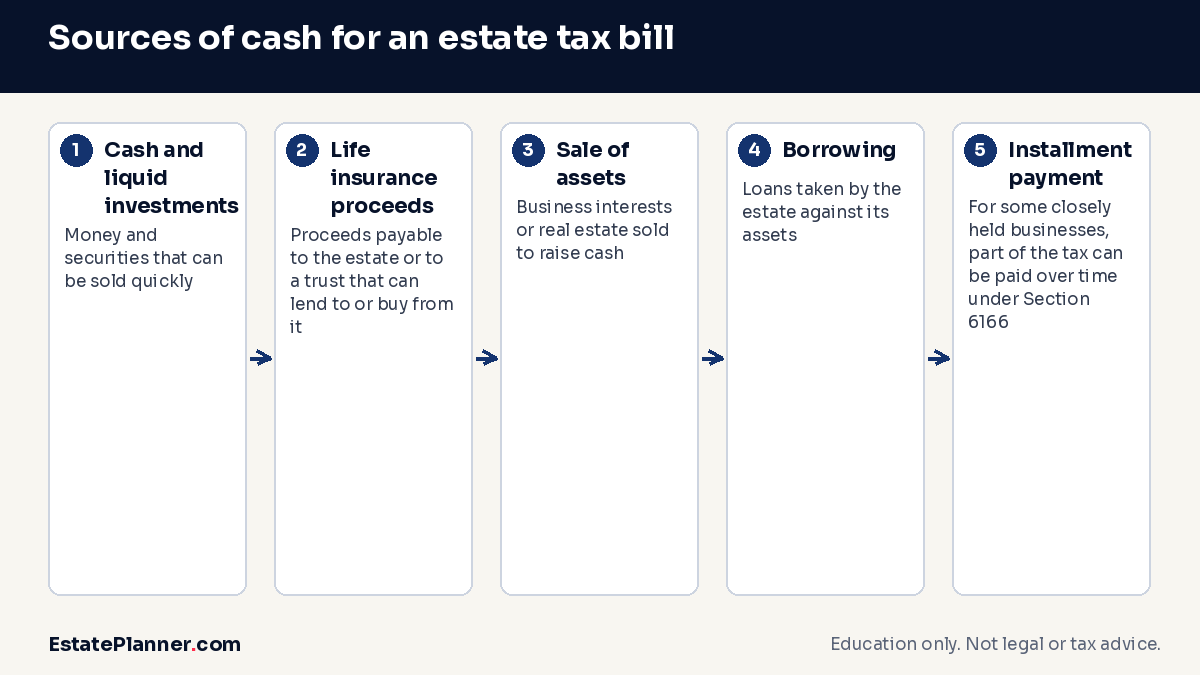
Insurance proceeds on the decedent’s life receivable by or for the estate are included in the federal gross estate, whether or not the estate is named as beneficiary.
If another beneficiary has a legally binding obligation to pay estate taxes, debts or other enforceable charges, inclusion extends to the proceeds required to satisfy that obligation.
The regulation also treats proceeds securing the decedent’s borrowing as receivable for the estate’s benefit. If local community property law makes half of estate payable proceeds the surviving spouse’s property, only the estate’s half is included under this rule.
Gross estate inclusion does not establish the amount of tax actually owed.
Transferring an existing policy
A transfer of a policy interest or relinquishment of a power within three years before death can cause estate inclusion if retaining it until death would have caused inclusion under the specified federal provisions.
Those provisions address retained enjoyment or income, certain reversions, powers to alter enjoyment, and life insurance ownership rights. A bona fide sale for adequate and full consideration in money or money’s worth is excepted.
The rule requires the decedent’s transfer or relinquishment. It does not apply solely because a trust purchased a policy within three years before the insured’s death.
Retained enjoyment, income or beneficiary designation powers also require review when retained for life, for a period measured by death, or for a period that does not actually end before death.
Premium contributions and withdrawal rights
The annual gift tax exclusion requires a qualifying present interest: an unrestricted right to immediate use, possession or enjoyment of property or its income. Future interests do not qualify, and the exclusion cannot exceed the present interest’s value.
In the Crummey case, enforceable withdrawal rights supported the exclusions allowed under the trust terms, circumstances and California law considered there. That historical decision does not establish a current nationwide state law rule, and other states differ.
Nominal withdrawal wording alone does not establish qualification. The decision also does not establish a universal statutory requirement to send written notices.
For your review meeting, gather contribution records, notices, delivery evidence, withdrawal demands, distributions and premium records. This is a recommended documentation checklist.
Donors subject to gift taxation must keep permanent records establishing their gifts, allowable deductions and information required for gift returns. They must retain documents and vouchers used to prepare returns and furnish requested supporting documents.
Loans and asset purchases require careful terms
In Minnesota, for example, trustees generally have powers to acquire property and make loans from trust property, except as limited by trust terms and subject to fiduciary duties. Other states differ.
A Minnesota trustee owes loyalty to beneficiaries and cannot place personal interests above theirs. The statute permits loans to beneficiaries on terms the trustee considers fair and reasonable under the circumstances.
A transaction with a decedent’s estate in which the trustee is a fiduciary or a beneficiary has an interest is not precluded by the cited loyalty provision if fair to beneficiaries.
This does not approve every transaction. Review a proposed loan or asset purchase alongside any binding obligation to pay estate liabilities.
Two related terms
Irrevocable life insurance trust: A trust used to hold life insurance. The label alone does not establish completed gift treatment or exclusion from the insured’s gross estate.
Incidents of ownership: Policy rights, including economic rights beyond legal title.
An Investor Advantage perspective on specialist help
"Now, I want to caution everyone watching this today, you have to know what you're talking about. You cannot dabble in the strategies that I'm about to discuss. It does take some work or in the beginning, you could partner with someone that knows what they're talking about."
Common questions
Does a policy gift or premium contribution require a gift return?
Yes, an individual donor must file a gift return for a policy gift or premium contribution outside the filing exceptions.
Filing and paying tax are separate questions. For a U.S. citizen or resident, an available gift tax credit can reduce the tax.
Filing exceptions cover transfers excluded under the annual exclusion or qualifying education and medical payment rules, deductible marital transfers, and qualifying deductible charitable transfers.
The charitable exception requires the donor’s entire interest and no disqualifying transfer of another interest, or a transfer qualifying under the special statutory rule for certain fractional charitable gifts.
For every life insurance policy listed on the return, obtain the insurer’s Form 712 and file it with the return.
Is a gifted policy valued at its cash surrender value?
Not automatically. Gift valuation starts with the insurer’s sale of the contract or comparable contracts.
For an existing policy requiring further premiums, an approximation may combine the interpolated terminal reserve and the portion of the last gross premium covering the period after the gift.
That approximation cannot be used if unusual contract features make it insufficiently close to full value.
For a paid up policy, the regulation’s example uses the insurer’s charge for a single premium contract of the same specified amount at the insured’s age.
The regulation’s insurance examples assume no accrued dividends or outstanding debt.
Can an irrevocable trust ever be changed?
Yes. In Minnesota, for example, an irrevocable noncharitable trust can be modified or terminated through specified consent procedures, but other states differ.
The settlor and all beneficiaries may consent even if the change conflicts with a material purpose.
With all beneficiaries consenting but without the settlor’s consent, termination requires a court finding that continuation is unnecessary to any material purpose. Modification instead requires a court finding that it is not inconsistent with a material purpose.
Without unanimous beneficiary consent, court approval requires that unanimous consent would have permitted the change and that nonconsenting beneficiaries’ interests are adequately protected.
These procedures establish neither a unilateral right to reclaim the policy nor a federal tax result.
Sources
- Internal Revenue Code §2042: Life insurance proceeds
- Treasury regulation §20.2042-1: Estate benefits and incidents of ownership
- Internal Revenue Code §2035: Transfers within three years of death
- Internal Revenue Code §2036: Retained life interests
- Internal Revenue Code §2037: Transfers taking effect at death
- Internal Revenue Code §2038: Powers to alter enjoyment
- Internal Revenue Code §2503: Excluded gifts
- Treasury regulation §25.2503-3: Present and future interests
- Crummey v. Commissioner: Withdrawal rights under the law and circumstances considered in that case
- Treasury regulation §25.6001-1: Gift records and insurer statements
- Internal Revenue Code §6019: Gift return filing and exceptions
- Internal Revenue Code §2522: Charitable deduction conditions
- Internal Revenue Code §2505: Gift tax credit for U.S. citizens or residents
- Treasury regulation §25.2512-6: Gift valuation of life insurance
- Minnesota trustee powers and their limits
- Minnesota specific trustee powers
- Minnesota trustee duty of loyalty
- Minnesota modification or termination by consent