
How buy-sell agreements govern ownership transitions
Key takeaway
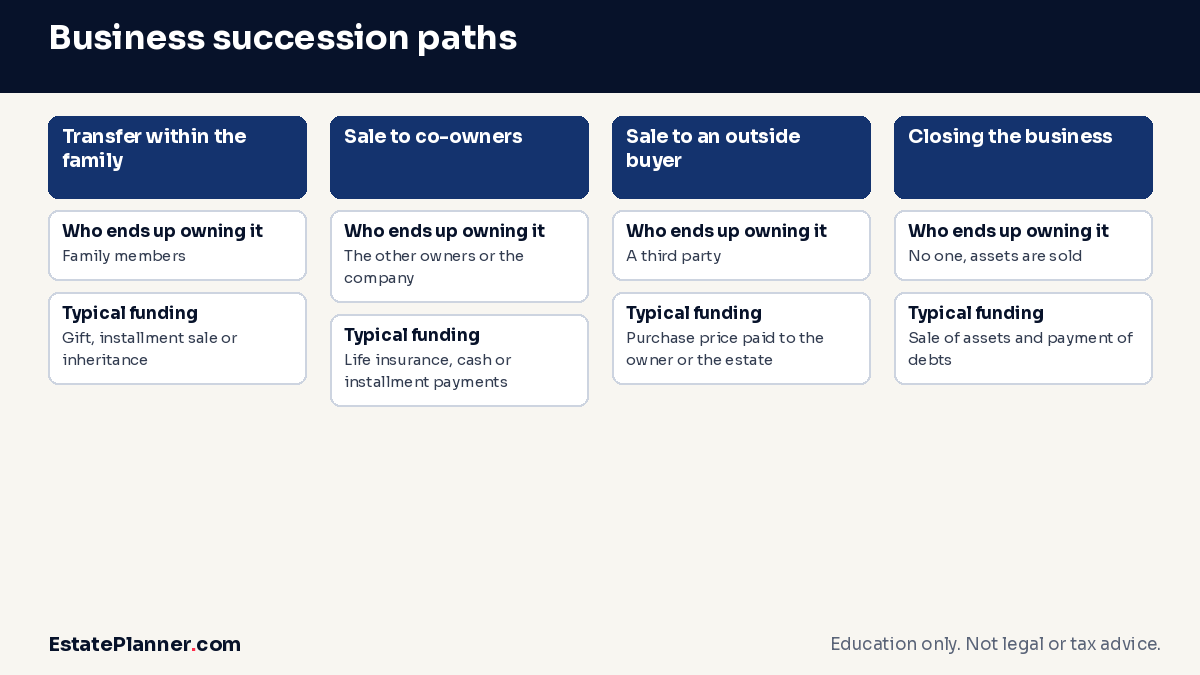
Owners can agree to purchase each other's shares at death and buy life insurance on each other to fund the purchase.
For your review with counsel, separate the proposed buyer, the purchase price, the insurance arrangement and the transfer documents. Use the distinctions below to focus that discussion.
Corporate transfer restrictions and notice
In Minnesota, for example, corporate transfer restrictions may appear in articles, bylaws, a shareholder resolution, or an agreement or other written action among security holders or between them and the corporation. Other states differ.
A written restriction must not be manifestly unreasonable under the circumstances. For specific enforceability, it must be conspicuously noted on the certificate or included in the prescribed information sent to holders of uncertificated shares.
A certificate statement identifying the existence of a restriction and referring to a separate document creating or describing it satisfies conspicuous notation.
Previously issued securities are not bound unless their holders agreed to the restriction or voted for it. Without the prescribed notice, a restriction is ineffective against a person who lacks knowledge of it.
LLC distributions and management rights
In Minnesota, for example, transferring an LLC transferable interest gives the recipient the transferred distribution rights. The transfer alone does not confer management participation or ordinary information rights, subject to the deceased member representative exception below. Other states differ.
The company need not recognize the recipient's rights until it has notice of the transfer. A transfer violating an operating agreement restriction is ineffective against a person who had notice of that restriction when the transfer occurred.
During winding up, a transferee may obtain an account of company transactions only from dissolution. A deceased member's representative has those accounting rights and, for estate settlement, current member information rights under the applicable statute.
Purchase price and estate tax value
A purchase price does not automatically establish estate tax value. For transfer tax valuation, an agreement to acquire property below fair market value, or a restriction on sale or use, is disregarded unless all three tests apply:
- It is a bona fide business arrangement.
- It is not a device to transfer property to family members for less than full and adequate consideration in money or money's worth.
- Its terms are comparable to similar arrangements entered into at arm's length.
For the comparability test, the restriction must reflect a fair bargain conforming to the general negotiated practice of unrelated parties in the same business.
Relevant considerations include the expected agreement duration, current fair market value, anticipated value changes and consideration for the rights granted. Isolated comparables do not establish general practice.
One commonly used valuation method can suffice, and terms need not match one particular agreement. When business uniqueness makes comparables difficult to find, similar business comparables may be used.
Insurance paid to the company
In Connelly v. United States, company owned life insurance funded a corporate obligation to redeem shares at fair market value. The Court held that the redemption obligation did not offset the insurance proceeds that increased company value.
A corporate obligation to redeem shares at fair market value is not necessarily a liability that reduces company value for federal estate tax purposes. The holding concerned the facts of that insurance funded redemption.
For your insurance review, ask counsel to compare the proposed policy owner and beneficiary with the buyer named in the purchase arrangement.
Two related terms
Cross purchase agreement: Owners agree to buy each other's shares at death and pay premiums on life insurance policies on each other to fund the purchase. Proceeds go to the surviving owner rather than the company.
Fair market value: For estate tax purposes, this is the price between a willing buyer and willing seller, neither under compulsion and both knowing the relevant facts, rather than a forced sale price. An elected alternate valuation rule may apply.
An Investor Advantage perspective
This talk offers a practical reminder to bring business liquidity, partner arrangements and tax planning into the same conversation.
"do you have a liquidity for your business? You know, if you have, partners, do you have buy sell agreements? Do you have, you know, a plan set up to pay the taxes? And do you have a tax problem in the future?"
Common questions
What basis rule applies to purchased property?
Purchased property's basis generally equals its cost, subject to other rules in the same subchapter and subchapters C, K and P of the Internal Revenue Code.
This rule concerns the purchased property, not the corporation's assets or surviving owners' existing shares.
Does a corporate redemption automatically receive exchange treatment?
No. A redemption within section 317(b) receives exchange treatment under section 302(a) only if a qualifying section 302(b) route applies.
Ownership is determined using section 318(a), except as provided in section 302(c)(2). If section 302(a) does not apply, section 301 treatment applies unless another provision of the subchapter provides otherwise.
Sources
- Minnesota Statutes, section 302A.429. Corporate transfer restrictions, adoption and notice.
- Minnesota Statutes, section 322C.0502. LLC transferable interests, distributions and information rights.
- Minnesota Statutes, section 322C.0504. Rights of a deceased member's representative.
- Internal Revenue Code, section 2703. Transfer tax treatment of purchase rights and restrictions.
- Treasury Regulation, section 25.2703-1. Comparable arrangements and general business practice.
- Treasury Regulation, section 20.2031-1. Estate tax fair market value.
- Connelly v. United States, Supreme Court opinion. Company owned insurance, redemption obligations and the cross purchase alternative.
- Internal Revenue Code, section 1012. Cost basis of purchased property.
- Internal Revenue Code, section 302. Corporate redemption tax treatment and ownership attribution.