
Trust types at a glance
Trust types differ mainly in when they are created and whether the creator can change them.
What the chart shows
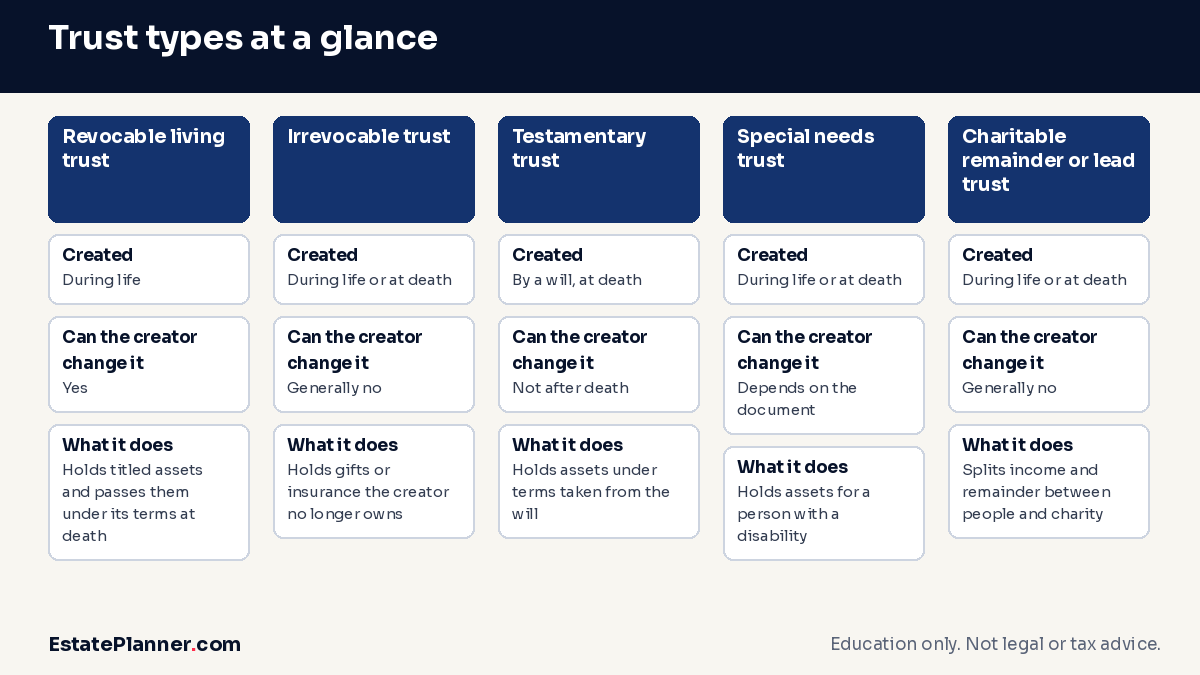
Trust types differ in when they are created, whether the creator can change them, and what they hold. The chart includes trusts created during life, at death, or at either point, with terms that range from changeable to generally fixed. Each row connects a trust type with its role in holding assets, gifts, insurance, or income and remainder interests.
For owners of businesses, real estate, and private investments, the chart offers a way to compare how different trust types hold assets and pass them under stated terms. It also shows that some trusts hold assets for a person with a disability, while another type splits income and remainder between people and charity.
How to read the chart
Start with the trust type column, which names revocable living, irrevocable, testamentary, special needs, and charitable remainder or lead trusts. The created column shows whether each type begins during life, at death, by a will at death, or at either point. Next, the change column describes whether the creator can change the trust, with answers of yes, generally no, not after death, or dependence on the document.
Read the final column for the purpose of each type. A revocable living trust holds titled assets and passes them under its terms at death, while an irrevocable trust holds gifts or insurance that the creator no longer owns. A testamentary trust holds assets under terms taken from the will, and a special needs trust holds assets for a person with a disability. A charitable remainder or lead trust splits income and remainder between people and charity.
Where owners see this in practice
The revocable living trust row connects titled assets with terms that apply at death. The irrevocable trust row connects gifts or insurance with property the creator no longer owns.
Other rows describe assets held under terms taken from a will or for a person with a disability. Together, the rows show different stated purposes for holding assets and interests.
The data behind the chart
Five common trust types differ in when they are created and whether the creator can change them.
| Trust type | Created | Can the creator change it | What it does |
|---|---|---|---|
| Revocable living trust | During life | Yes | Holds titled assets and passes them under its terms at death |
| Irrevocable trust | During life or at death | Generally no | Holds gifts or insurance the creator no longer owns |
| Testamentary trust | By a will, at death | Not after death | Holds assets under terms taken from the will |
| Special needs trust | During life or at death | Depends on the document | Holds assets for a person with a disability |
| Charitable remainder or lead trust | During life or at death | Generally no | Splits income and remainder between people and charity |
Common questions
Which trust types can be created during life or at death?
The chart lists irrevocable trusts, special needs trusts, and charitable remainder or lead trusts as created during life or at death. Revocable living trusts are created during life, while testamentary trusts are created by a will at death.
Which trust types can the creator change?
The creator can change a revocable living trust. An irrevocable trust and a charitable remainder or lead trust are generally not changeable, a testamentary trust cannot be changed after death, and a special needs trust depends on the document.