
Fiduciary roles map
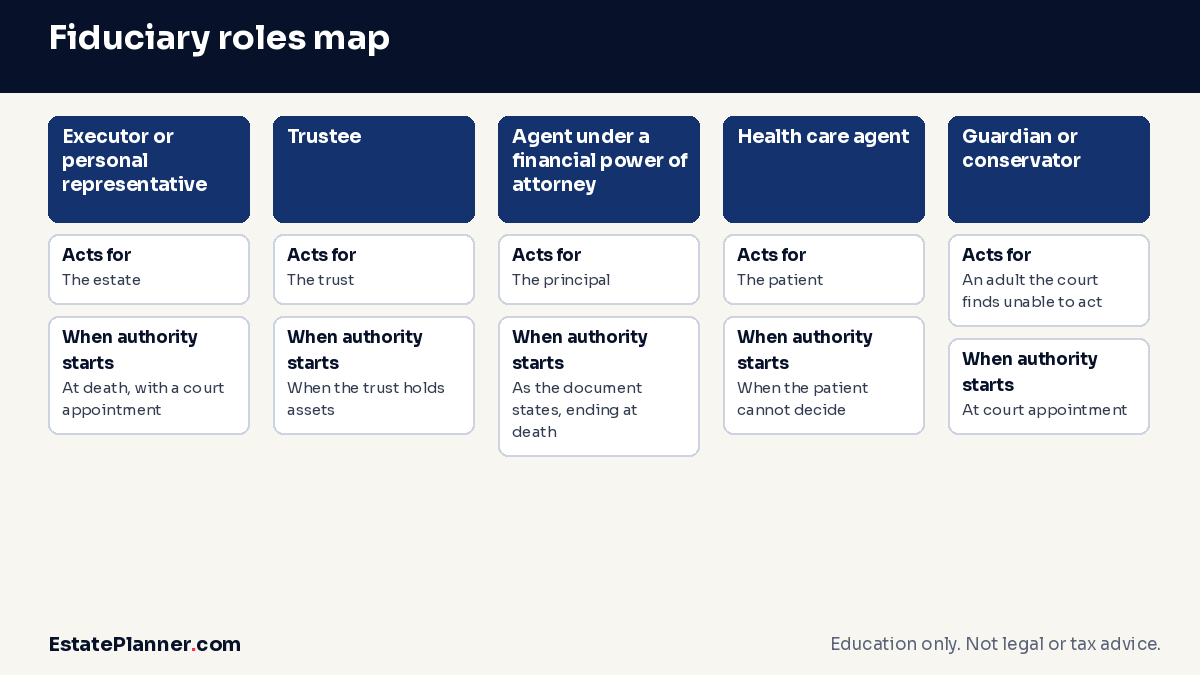
Five fiduciary roles act for different people or property and start at different times.
What the chart shows
The chart maps fiduciary roles by who each role acts for and when its authority begins. Each row pairs a role with the person or entity on whose behalf it works. A final column shows the trigger that gives the role its power to act.
How to read the chart
The first column names the role, starting with the executor or personal representative and ending with the guardian or conservator. The middle column shows whom the role acts for, which differs from row to row. The last column gives the starting point of authority, which runs from death with a court appointment to the moment a trust holds assets. Reading across a row shows that the financial agent role runs as the document states and ends at death, while the health care agent role starts when the patient cannot decide.
Where owners see this in practice
Owners with business interests, real estate or private investments often find that several of these roles touch the same holdings. A trustee acts for the trust once the trust holds assets, so the timing of ownership matters to when that role has authority. An executor acts for the estate only at death with a court appointment, which separates that role from a financial agent whose authority ends at death. A guardian or conservator acts only after a court finds an adult unable to act, and a health care agent begins when the patient cannot decide.
Common questions
When does an executor or personal representative gain authority?
The chart shows authority starting at death, with a court appointment.
When does a trustee begin to act?
The trust is the party the role serves.